
Dear Reader,
I want to tell you why this exists. Not the business plan version. Not the elevator pitch. The real reason — the one that kept me awake at night and eventually made me do something about it.
Dinners With Friends started with a feeling I could not shake. A sense that something fundamental had broken in the way we live alongside each other, and that no one was really talking about it honestly. People were lonely. Not in the dramatic, cinematic way. In the quiet, everyday way that creeps in so slowly you barely notice until one evening you realise you cannot remember the last time you sat across a table from someone and had a proper conversation.
I saw it everywhere. In the friend who moved to a new town and spent six months without a single social invitation. In the colleague who retired and discovered that without the structure of work, his phone simply stopped ringing. In the woman at a community event who told me, with an embarrassed laugh, that she had not eaten dinner with another person in over three months. In the young professional who had hundreds of followers online and no one to call when she had a bad day.
These are not unusual stories. They are ordinary ones. And that is precisely what makes them so troubling.
The Numbers Behind the Feeling
I am not someone who ignores data when it is staring me in the face. And the data on loneliness in Britain is staring hard.
England's Community Life Survey for 2024/25 found that 6.6% of adults — around three million people — feel lonely often or always. The figure has edged down from 7.1% the year before, which is welcome, but it has barely moved in a decade. Among young adults aged 16 to 24 it is 9%, the highest of any age band. Among disabled adults it is 14%, against 3% of non-disabled adults. And people in the most deprived tenth of areas are nearly three times as likely to feel persistently lonely as those in the least deprived — 11% against 4%.
The health consequences are serious. Loneliness and isolation are associated with higher risks of depression, heart disease and stroke: Valtorta's 2016 review in Heart put the increase at 29% for coronary heart disease and 32% for stroke. Julianne Holt-Lunstad's work is where the comparison with smoking comes from — her meta-analyses benchmark the mortality effect of weak social connection against well-known risks like smoking. It is a benchmark, not an equivalence, and it is quoted so often it has almost lost its power to shock. It should not. We are talking about something that shortens lives, and we have normalised it.
Here in Devon, I do not think the picture is any better. In rural and coastal communities — the places I know and love — geographic isolation compounds social isolation. Limited public transport means that getting to a social event can be a genuine logistical challenge. The closure of pubs, post offices, and community centres has stripped away the informal gathering places where connections once formed naturally. And the beautiful countryside that draws people here can, paradoxically, make it harder to stumble into the kind of casual, repeated interactions that friendships actually need to form.
The UK was the first country in the world to appoint a Minister for Loneliness, back in 2018. The brief still exists — it sits with Stephanie Peacock at the Department for Culture, Media and Sport as Minister for loneliness and social connection — and the government's approach leans on community spaces, social prescribing through the NHS, and the grassroots organisations that bring people together. Dinners With Friends is part of that grassroots response.
The Moment It Clicked
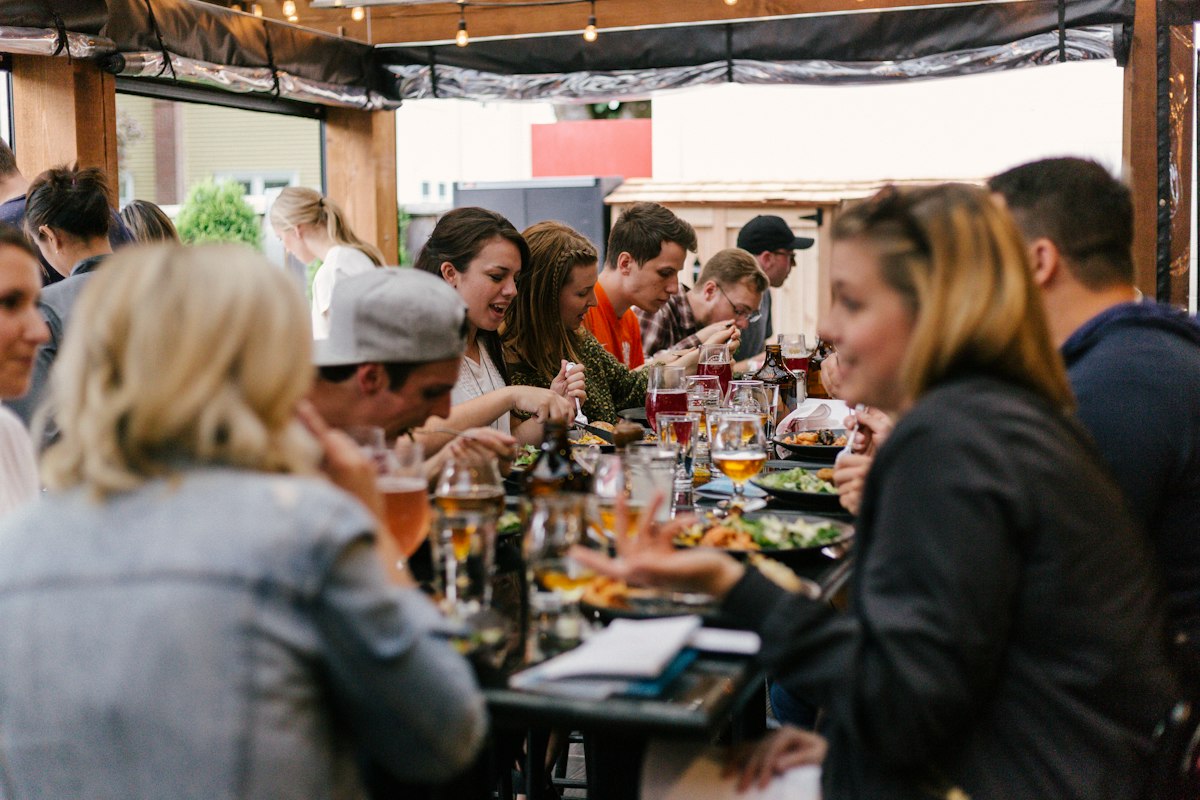
I remember the exact evening it came together for me. I was at a dinner — not one I had organised, just a normal dinner with people I did not know particularly well. Someone had put a group together: a few friends of friends, a couple of near-strangers, a table at a decent restaurant. Nothing fancy. Nothing structured. Just food and people.
Within twenty minutes, something shifted in the room. The initial awkwardness melted. Someone told a story that made the whole table laugh. Someone else asked a question that went deeper than the usual surface-level pleasantries. By the time the main course arrived, I was in a conversation about grief with a woman I had met an hour earlier, and it felt more honest and more nourishing than anything I had experienced in months.
I drove home that night thinking: this is it. This is what people are missing. Not another app. Not another networking event with name badges and forced small talk. Just a table, good food, and the space to be human with other humans.
The thing that struck me most was how simple it was, and yet how rare. When did sitting down to eat with people become something we have to deliberately engineer? There was a time when it happened naturally — Sunday lunches, neighbourhood dinners, the kind of communal eating that held communities together for centuries. Professor Robin Dunbar's national survey work at the University of Oxford points at what our grandparents already knew: people who eat with others more often are happier, more satisfied with life, more trusting, and more connected to the place they live. His explanation is the endorphin system — the neurochemistry that underpins human bonding — though that is his hypothesis rather than something the survey measured.
We did not lose this because people stopped wanting it. We lost it because modern life made it inconvenient, and we let convenience win.
What I Wanted to Build
I did not want to build a dating app. I did not want to build a networking platform. I did not want to create another social media space where people perform connection without actually experiencing it.
I wanted to create something that felt more like what that dinner felt like. Warm. Unpretentious. Real. A space where you could turn up as yourself — not your LinkedIn self or your Instagram self, but the version of you that emerges when you are relaxed, well-fed, and in good company.
The vision was specific: curated groups of people who do not know each other, brought together at carefully chosen restaurants, with the menu published in advance so nobody arrives not knowing what they are walking into, and a host who greets you and makes the introductions. You order and pay for your food and drink at the venue, as you would on any other night out. No agendas. No pressure to exchange business cards or follow each other on anything. Just dinner.
I wanted it to feel like being invited to a friend's dinner party — except the friend has excellent taste in restaurants and has somehow assembled a table of people you would never have met otherwise.
And I wanted it to be regular. Because the research is unambiguous on this point: friendship is not built in a single evening. It is built through repeated contact over time. Jeffrey Hall, at the University of Kansas, found it takes around 50 hours together to move from acquaintance to casual friend, about 90 to become a friend, and more than 200 hours to develop a close friendship. One dinner will not change your life. But twelve dinners might. Twenty might. The kind of slow, steady accumulation of shared experiences that turns strangers into the people you call when things go wrong — or when you just want someone to share good news with.
The People Who Show Up
The thing that has moved me most since we started is the people. Not in the abstract. In the specific, personal, sometimes heartbreaking, often joyful reality of who walks through the door.
There was the man in his early fifties who had recently divorced and realised that most of his social life had been his wife's social life. He came to his first dinner alone, visibly nervous, and left three hours later with plans to meet two other guests for a walk that weekend. He has been to every dinner since.
There was the woman who had moved to Devon for work and spent her first year knowing almost no one outside her office. She told me after her second dinner that it was the first time since moving that she felt like she might actually belong here.
There was the retired teacher who admitted, with a candour that stopped me in my tracks, that there were weeks when the only extended conversation she had was with the person at the supermarket checkout. She is now part of a group of six who meet for dinner monthly — a group that did not exist until she pulled up a chair at one of our tables.
I could tell you a hundred stories like these. Each one is a reminder of something I believe deeply: people are not antisocial. They are underserved. The desire for connection is there — burning, in many cases — but the infrastructure has been stripped away. The pubs have closed. The community centres have lost their funding. The third places where people once gathered informally have been replaced by drive-throughs and delivery apps.
If any of these stories sound familiar — if you have felt that quiet ache of wanting more connection but not knowing where to find it — you are not alone. YouGov's friendship study found that 51% of Britons find it difficult to make new friends. The fact that it feels hard is not a reflection of you. It is a reflection of a society that has made friendship structurally difficult.
The Philosophy
I want to be honest about what Dinners With Friends is and what it is not.
It is not a cure for loneliness. Loneliness is complex, deeply personal, and sometimes requires professional support. We point people towards Samaritans on 116 123, Mind's Infoline on 0300 123 3393, and NHS social prescribing through a GP, because there are times when a dinner is not enough and we do not pretend otherwise.
What it is, I hope, is a door. A low-barrier, low-pressure entry point into the kind of regular social contact that the science of social resilience tells us is protective — against loneliness, against poor mental health, against the slow erosion of wellbeing that comes from living in a society that has forgotten how to gather.
Our philosophy rests on a few simple convictions:
Everyone deserves a seat at the table. Not just extroverts, not just people with existing social networks, not just people who find small talk easy. Everyone. We design our dinners to be welcoming to people who are nervous, people who are new to an area, people who have not been out socially in months. The table does not judge.
Food is not incidental. It is central. The act of sharing a meal is one of the oldest human rituals — a practice that spans every culture and every era. There is a reason we instinctively bring food when someone is grieving, celebrating, or in need of comfort. Food is how we say: you are welcome here. You belong.
Consistency matters more than spectacle. We are not interested in one-off events. We are building a rhythm — regular dinners where you see familiar faces alongside new ones, where relationships have time to deepen, where showing up becomes a habit rather than a novelty. The research on what loneliness does to your brain and body makes clear that sporadic socialising is not enough. Connection needs to be sustained.
Community is built from the bottom up. No government programme, no app, no algorithm can replicate what happens when a group of people choose to sit down together and be present. Community is not a product. It is a practice — one dinner, one conversation, one evening at a time.
The Vision
We started in Devon because this is home. Because I could see the need in the communities around me — the rural isolation, the shrinking social infrastructure, the people who were quietly struggling with disconnection and had no idea that everyone around them was feeling the same way.
But the need is not unique to Devon. It is everywhere. In cities where people live on top of each other and still feel utterly alone. In suburbs where the friendship deficit is built into the architecture. In towns that have lost their gathering places. In every postcode where someone is sitting at home tonight wishing they had somewhere to go and someone to go with.
The vision for Dinners With Friends is simple: more tables, more towns, more people pulling up a chair. Not because it is a clever business model, but because I genuinely believe that one of the most radical things you can do in a disconnected world is to sit down and eat with someone.
An Invitation
If you have read this far, I want to say something directly to you.
You do not need to be the right kind of person to come to a dinner. There is no right kind. You do not need to be outgoing, or witty, or well-connected. You do not need to know anyone. You do not even need to be sure you want to do it. You just need to be willing to try.
Almost everyone who has walked through the door to one of our dinners has felt nervous first. The man in his fifties, the woman new to Devon, the retired teacher, the young professional, the couple looking to expand their social circle — all of them hesitated before they booked. All of them are glad they did.
The table is set. The wine is poured. There is a chair with your name on it, next to someone you have not met yet but who might just change your evening, your week, your year.
I started Dinners With Friends because I believe that people are good, that connection is essential, and that a shared meal is one of the most powerful tools we have for building the kind of community that makes life worth living.
Come and eat with us. That is all I am asking. The rest will take care of itself.
With warmth,
Pamela
Dinners With Friends hosts regular curated dinners in Devon, bringing together people who want more from their social lives. Every dinner is designed to feel welcoming, relaxed, and genuinely enjoyable — whether it is your first time or your fifteenth. If something in this letter resonated with you, we would love to see you at the table.