
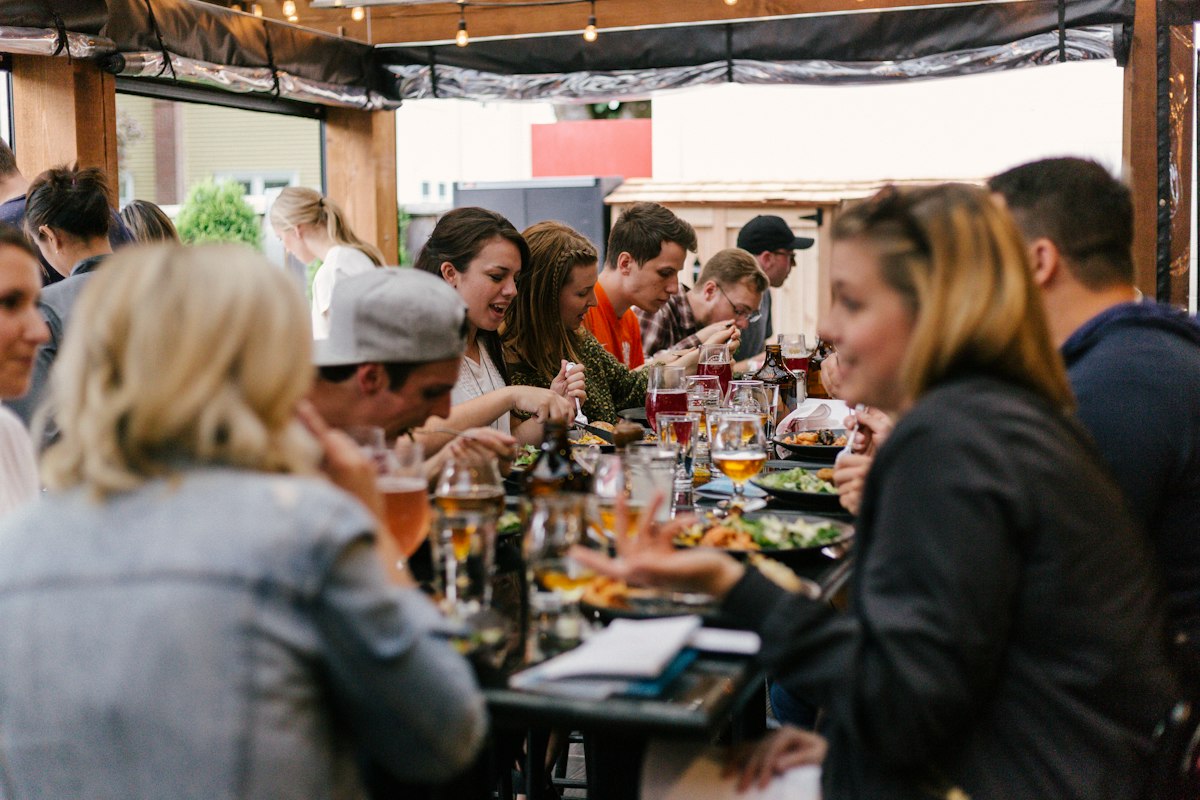
The Big Night Out Is Getting Smaller
Something has been shifting in how Brits socialise, and if you have felt it yourself, you are not imagining things. The era of the massive night out — packed clubs, heaving bars, sprawling house parties where you barely know half the people — is quietly giving way to something different. Something smaller, slower, and more intentional.
The numbers tell part of the story. Night Time Industries Association figures show the UK lost 480 nightclubs between June 2020 and June 2024 — an average of ten a month. Yorkshire alone saw nightclub numbers fall by 45% over that period, and London by 29%. Eight pubs a week were being demolished or converted across England and Wales in the first half of 2025.
But it would be a mistake to read this purely as decline. Something else is growing in the spaces being left behind.
OpenTable's 2026 dining trends research — 2,005 UK adults, surveyed in September 2025 — found that more than a third of Brits, 36%, want to see more group and private dining options, and that 44% would rather eat with others than alone. National Geographic Traveller has written about what it calls London's "evolving supper club scene". The trend is clear: people are not socialising less. They are socialising differently.
And there are very good reasons why.
Why Uncertainty Makes Us Crave Smaller Groups
We are living through a period of sustained uncertainty. The cost of living crisis. Global instability. The lingering psychological effects of the pandemic. A political landscape that feels unpredictable. When the world outside feels chaotic and beyond our control, our social instincts respond in a particular way.
Psychologists call it the "tend and befriend" response. When we feel threatened or anxious, we do not just fight or flee — we also move toward our closest social bonds. We pull inward, toward the people we trust most. We seek environments that feel safe, predictable, and manageable.
A nightclub with 500 people does not meet that need. A dinner table with six people does. As we explore in how sharing a meal can change your social life, the dinner table has always been where real bonds form.
This is not about fear or avoidance. It is a healthy, adaptive response. When everything feels uncertain, we look for pockets of certainty. We gravitate toward social settings where we can relax, be ourselves, and feel genuinely seen — rather than performing for a crowd or shouting over music to someone whose name we will not remember tomorrow.
The Canadian Social Connection Survey found that people felt less emotionally close to the others present as gatherings got bigger, and that enjoyment peaked at gatherings of five to eight people before falling away. Our brains are simply not wired to hold meaningful connections across a crowded room. Small groups are not the compromise — they are the ideal.
The Magic Number: Why 4-8 People Is the Sweet Spot
Robin Dunbar, the Oxford evolutionary psychologist famous for "Dunbar's Number" — the theory that humans can maintain roughly 150 stable social relationships — also identified a nested structure within our social networks. At the innermost layer, we have about five people to whom we devote 40% of our available social time. The next layer out is about 15.
But when it comes to face-to-face interaction — the kind that actually builds bonds — observation points to an even tighter range. Studies of how people cluster in public, going back to Bakeman and Beck's 1974 work in Environment and Behavior, find that we most often assemble in groups of four or fewer.
The Social Connection Guidelines, an evidence-based resource published by the Canadian Alliance for Social Connection and Health, put the cognitive limit for a single conversation at about four or five people — which is precisely why enjoyment peaks at gatherings of five to eight, big enough to split into more than one conversation without anyone being stranded. Beyond eight, participation becomes uneven. Quieter voices get drowned out. Conversations splinter. The sense of shared experience — everyone on the same page, everyone contributing — begins to fracture.
Think about the best social evenings you have had. Not the biggest or the loudest, but the ones you actually remember with warmth. The chances are high that they involved a handful of people, a comfortable setting, and enough time for conversation to go somewhere real.
That is not coincidence. It is how we are built.
The Rise of the Supper Club
The UK's growing supper club movement is a direct expression of this shift. What started as underground dining experiences in people's homes has evolved into a diverse ecosystem of intimate culinary events — from pop-up kitchens in converted warehouses to curated dinners in private rooms of established restaurants.
National Geographic Traveller reported on London's evolving supper club scene in early 2026, describing gatherings that have moved from word-of-mouth secrets into the mainstream of the city's dining. But the appeal is not primarily about the food. It is about the format.
Supper clubs work because they combine several things that matter:
A defined group size. Most cap attendance at somewhere between six and twelve people. Everyone can talk to everyone. Nobody gets lost.
Shared intention. Everyone at the table has chosen to be there. They want to meet people, have conversations, and enjoy good food. That shared intent removes one of the biggest barriers to adult socialising — the uncertainty about whether the other person is actually interested in connecting.
Structure without rigidity. The meal provides a natural rhythm. Courses arrive. Plates are shared. Wine is poured. There is enough structure to prevent awkwardness, but enough flexibility for the evening to find its own shape.
A sensory anchor. The food gives people something immediate to talk about, react to, and bond over. It is much easier to start a conversation about the starter in front of you than to approach a stranger cold in a bar.
This is not a niche trend. It reflects a broader cultural reorientation toward quality over quantity in our social lives.
What We Lost in the Age of the Mega-Event
There is nothing wrong with big events. Festivals, concerts, sporting events — these have their own energy and their own rewards. But somewhere along the way, a lot of British social life defaulted to the large and loud, and we stopped noticing what we were missing.
In a packed bar, you can spend three hours and leave without having had a single meaningful conversation. In a nightclub, the music makes real talk nearly impossible. At a large dinner party, you might speak properly to the two people either side of you and wave at everyone else. These settings are fun, but they are not where friendships are built.
Jeffrey Hall's research at the University of Kansas showed that it takes around 50 hours of time spent together to move from acquaintance to casual friend, about 90 to become a friend, and over 200 hours for a close friendship. Crucially, Hall found that hours logged at work do not count the same way — the key word is "quality" — real conversation, shared laughter, genuine exchange. Not standing next to someone at a bar while you both look at your phones.
If you want to deepen a friendship, do not plan a big night out. Plan a small dinner. The intimacy of a shared meal with a handful of people creates more bonding in two hours than a crowded party does in five. Quality always beats quantity.
Small gatherings are quality-dense. Every minute counts. Every person matters. That efficiency — if you can call it that — is exactly what time-poor, connection-hungry adults need.
The Sober Curious Factor
There is another thread woven into this shift. Young people in the UK are drinking significantly less than previous generations. Mintel's 2023 research found around a third of 18- to 24-year-olds do not drink alcohol at all, and that 40% of 16- to 24-year-olds had cut down over the previous year. In England, the share of 16- to 24-year-olds drinking weekly fell from 67% in 2002 to 37% in 2021, according to the Health Survey for England.
The shift shows up in the national numbers too: peer-reviewed analysis in Addiction found UK alcohol duty receipts running £10.3bn — 12.3% — below the pre-2020 trend. And Alcohol Change UK polling found 29% of UK adults, around 15.5 million people, planned to take part in Dry January 2025.
This matters because so much of traditional British socialising has been built around drinking. The pub. The bar. The club. When a growing segment of the population is choosing not to drink — or to drink less — the appeal of these alcohol-centred settings diminishes. People want social experiences that do not revolve around a pint glass.
Dinner fills that gap perfectly. You can have wine if you want it. You can have sparkling water if you do not. Nobody notices or cares, because the focus is on the food and the conversation, not on what is in your glass. For the sober curious generation, the dinner table is a far more comfortable social space than the bar — and there are ways to stay connected and socialise even on a budget.
Anxiety and the Need for Predictability
Let's talk honestly about anxiety, because it is a bigger factor in social choices than most people admit.
Research from King's College London found that three in five Britons — 60% — said the cost-of-living crisis was negatively affecting their mental health. ONS data shows around a quarter of British adults feel lonely at least some of the time, with 7% lonely often or always; among 18- to 24-year-olds, YouGov found 24% are often lonely and a further 7% lonely all the time. We are a nation under strain, and when people are anxious, their tolerance for unpredictable social situations drops.
A big night out is inherently unpredictable. You do not know who will be there, how crowded it will be, how much it will cost, or when you will get home. For someone already carrying background anxiety about money, work, or life in general, that unpredictability can be enough to make them cancel altogether.
Small, structured gatherings offer the opposite. You know who is coming. You know where you are going. You know what it will cost. You know roughly when it will end. That predictability is not boring — it is reassuring. It lowers the activation energy required to actually show up.
And showing up is everything. The biggest barrier to a better social life for most adults is not a lack of desire. It is a lack of follow-through. We want to see people. We plan to see people. And then, when the evening comes, we are tired, anxious, or overwhelmed, and we cancel. Small, predictable, low-stakes gatherings are the antidote to the cancellation culture that has quietly gutted so many friendships. If this sounds familiar, our introvert's guide to building a social life you actually enjoy is worth a read.
If you find yourself regularly cancelling plans because the thought of a big social event feels overwhelming, you are not antisocial. You might just need a different kind of social event. Smaller, calmer, more structured. The problem may not be you — it may be the format.
What This Means for How We Build Friendships
The shift toward smaller gatherings is not a retreat from social life. It is an evolution of it. People are getting smarter about how they spend their limited social energy. They are choosing depth over breadth, connection over spectacle, and real conversation over performative fun.
This is good news, because everything we know about friendship suggests that depth is what matters. Dunbar's research shows that we devote 40% of our social time to our five closest people. Those five relationships — not our 500 Instagram followers — are what protect us against loneliness, depression, and ill health. Building regular social rituals is one of the most effective ways to nurture them.
Small gatherings are where those relationships are nurtured. Not in the crowd, but around the table. Not shouting over music, but passing the bread and asking how someone really is.
Finding Your Table
If any of this resonates — if you have been feeling that big social events leave you drained rather than energised, or that you crave something more meaningful than another loud night out — you are part of a much larger shift. Millions of people across the UK are looking for the same thing.
The beauty of the small gathering is that it does not require much. A few people, a meal, some uninterrupted time. You can create that yourself — invite three or four people over, cook something simple, put the phones away. Or you can find it through communities and events designed around exactly this kind of connection.
That is what we built Dinners With Friends to be. Small tables. Good food. Real conversation. No performance required. Just people being people, over a shared meal. See how it works and find an evening near you.
The big night out had its moment. But the small gathering? That is where the good stuff happens.