
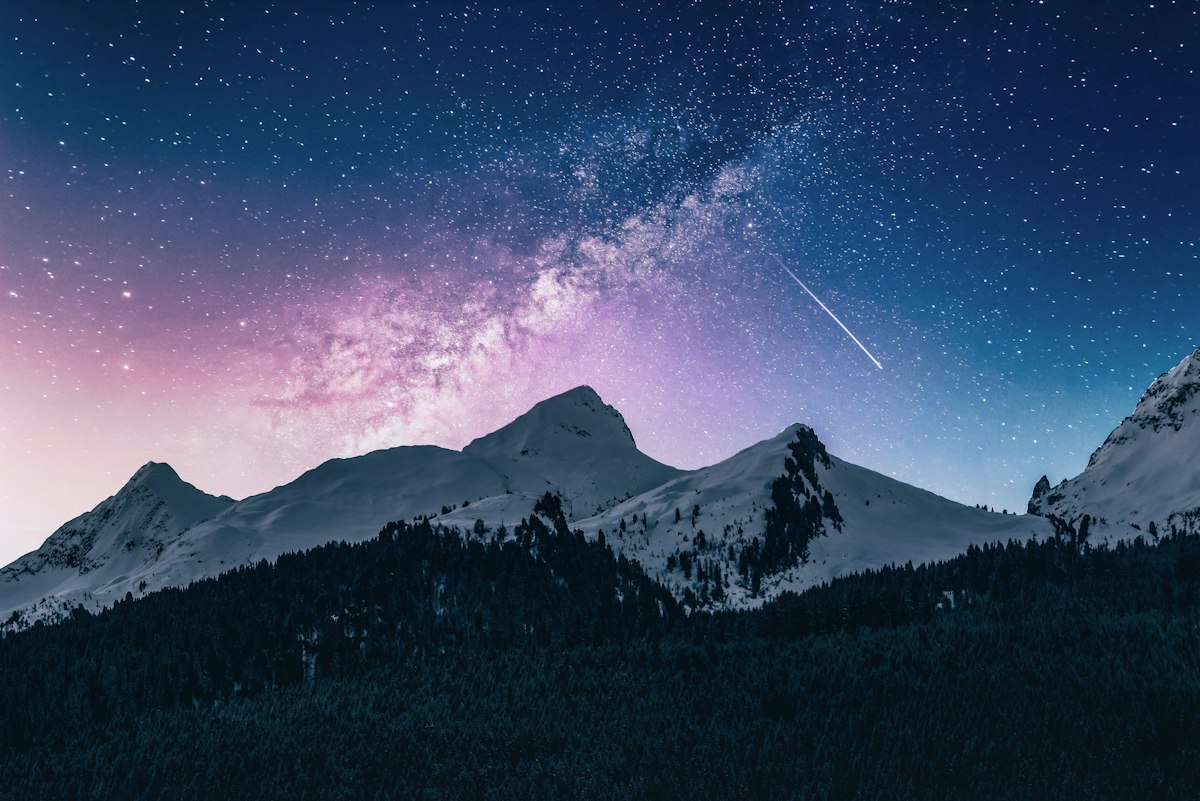
Looking Up Together
There's a particular kind of magic that happens when you stand outside on a clear night with friends and look up. The conversation slows, then stops. Someone points at something. Someone else asks a question nobody can answer. You stand there in the cold, necks craned, and for a few minutes the usual noise of life — work, phones, schedules, the endless scroll — simply falls away.
Stargazing is one of the most bonding things you can do with people, and almost nobody does it. We've lost our connection to the night sky in a way that would baffle every previous generation of humans. Light pollution has erased the stars from most of our lives. In central London, you can see perhaps a dozen stars on a clear night. Our ancestors saw thousands — the full sweep of the Milky Way arching overhead, so bright it cast shadows.
Devon is one of the best places in England to see what we've been missing. The county has some of the darkest skies in the country, with two national parks — Exmoor and Dartmoor — offering genuine darkness that's increasingly rare in southern England. On a clear night in the right spot, you can see the Milky Way with the naked eye, pick out individual planets, and watch shooting stars streak across a sky so full of light it's hard to believe it's the same one you see from your garden.
And the best part? You don't need a telescope. You don't need to know anything about astronomy. You just need a clear night, a dark spot, warm clothes, and someone to share it with.
Exmoor: Europe's First International Dark Sky Reserve
Exmoor National Park was designated Europe's first International Dark Sky Reserve — a recognition of the exceptional quality of its night skies and the community's commitment to keeping them dark. On a cloudless night, you can see literally thousands of stars and astronomical sights such as the Milky Way with the naked eye.
The designation isn't just honorary. It means that light pollution is actively managed across the park, with street lighting and commercial lighting designed to minimise upward light spill. The result is a darkness that feels genuinely different — richer, deeper, more alive than anywhere most people have experienced.
Best Spots on Exmoor
Dunkery Beacon is the highest point in the national park at 519 metres above sea level, and one of its official Dark Sky Discovery Sites. The summit gives an unobstructed view of the surrounding sky. Set up on the south side of the beacon, which isn't affected by any residual light from Minehead to the north. On a clear night, the sky from Dunkery is breathtaking — the Milky Way is vivid, and the sheer number of visible stars can feel overwhelming the first time you see it.
Wimbleball Lake is a favourite with astrophotographers and a firm favourite for stargazing. Now an official Dark Sky Discovery Site, it has a dedicated stargazing hub overlooking the water, with low-level seating and a flat stone terrace for setting up telescopes. The stars reflecting in the lake add a particular beauty — you're surrounded by light above and below.
Bossington Hill on the coast is another excellent spot, offering darkness over the Bristol Channel with no light sources to the north.
The Exmoor Dark Skies Festival
Every October, Exmoor National Park hosts the Dark Skies Festival — a two-to-three-week programme of events at locations across the moor. The 2026 festival runs from 16 October to 1 November and features dozens of events including guided stargazing sessions, planetarium experiences, astronomy suppers, dark skies yoga, wildlife walks, campfire stargazing, and family activities.
The festival is an excellent way to get into stargazing for the first time. The guided sessions are led by knowledgeable astronomers who can point out constellations, explain what you're seeing, and answer the questions that inevitably tumble out when you're staring at the universe. Booking opens in advance and popular events fill quickly.
Exmoor is about an hour and a half from Exeter by car. For a stargazing trip, drive up in the late afternoon, have dinner in one of the local pubs — the Royal Oak Inn at Withypool or the Crown Hotel at Exford are both excellent — and then head to your chosen spot as darkness falls. Give your eyes at least twenty minutes to adjust to the dark before you start looking up properly. The difference between "just arrived" eyes and properly dark-adapted eyes is remarkable.
Dartmoor: Wild Skies
Dartmoor doesn't hold an official Dark Sky Reserve designation, but large parts of the moor offer darkness that rivals Exmoor. The national park covers 954 square kilometres of open moorland, and its interior — away from the towns around the edges — is genuinely dark. The elevated, open landscape means huge skies with unobstructed horizons in every direction.
Best Spots on Dartmoor
Haytor Rocks is one of the most popular stargazing spots, and for good reason. The car park provides easy access, the elevated position gives clear views, and the granite tor itself makes a dramatic foreground for photographs. It can be busy on clear weekend nights — you won't be the only person with this idea — but there's plenty of space.
Gutter Tor is more isolated and therefore darker. Its distance from nearby towns means very little ambient light, and the open moorland gives an expansive, uninterrupted view of the sky. You'll need to walk a short distance from the nearest parking, so bring a torch — ideally with a red light setting, which preserves your night vision.
Hound Tor near Manaton offers easy access and particularly good visibility. The rocks rise to around 410 metres above sea level, and the walk from the car park is short. Local stargazers rate it highly.
Burrator Reservoir combines dark skies with the pleasure of seeing stars reflected in the water. Low ambient light, convenient access, and the added dimension of the reflection make it a beautiful spot.
Castle Drogo deserves a special mention. Researchers have pinpointed the skies above the castle as providing excellent stargazing conditions due to the hill height, low light pollution, and favourable weather patterns. The area around the castle often has clear views of the Milky Way. Castle Drogo is also one of Devon's finest gardens and country estates — you could visit the gardens during the day and return for stargazing in the evening.
Dartmoor has the advantage of being closer to Exeter than Exmoor — you can reach the central moor in about thirty minutes. That makes it viable for a spontaneous evening trip when the sky is clear, rather than requiring the planning that an Exmoor visit demands.
The South Devon Coast
Devon's southern coastline offers a different stargazing experience. Headlands like Start Point and Prawle Point in the South Hams have minimal light pollution, elevated positions, and the dramatic addition of starlight over open ocean. There's something extraordinary about watching the Milky Way arc across a sky that meets the sea at the horizon.
These spots are more remote and require more care — coastal paths at night need proper torches and sturdy footwear — but the combination of dark sky, crashing waves, and salt air creates an atmosphere that's hard to beat.
The key advantage of coastal stargazing is the horizon. Inland, even in dark locations, you're often surrounded by slightly lighter skies near the horizon where distant towns cast a glow. On a south-facing headland, the ocean gives you pure darkness all the way down.
When to Go
Stargazing in Devon is possible year-round, but some conditions and events make certain times significantly better than others.
The basics: You need clear skies, obviously, and as little moonlight as possible. The new moon phase (when the moon isn't visible) gives the darkest skies. A full moon washes out everything but the brightest stars and planets. Check the moon phase before you go — there's no point driving to Dartmoor if the full moon is going to flood the sky with light.
Best months: Autumn and winter offer the longest hours of darkness and often the clearest air. September through March gives you darkness by early evening, which means you don't have to stay up until midnight. Summer stargazing is possible but means very late nights — true darkness doesn't arrive until after 10pm in June.
Meteor Showers in 2026
Two major meteor showers make 2026 an exceptional year for Devon stargazers:
The Perseids peak on 13 August 2026, with the potential for more than a hundred meteors per hour. Crucially, the 2026 Perseid peak coincides with a new moon, meaning conditions will be ideal — no moonlight to wash out the fainter shooting stars. The best viewing time is between midnight and 5:30am, though meteors can be visible from dusk. The Perseids are the crowd-pleaser of the meteor shower calendar — reliable, prolific, and happening in warm weather.
The Geminids peak on the night of 13-14 December 2026. A thin waxing crescent moon sets in the mid-evening, so conditions for the rest of the night are excellent. The Geminid meteors are particularly beautiful — very bright, moderately fast, and unusually colourful, with white, yellow, green, red, and blue shooting stars caused by traces of metals like sodium and calcium burning up in the atmosphere.
Mark 13 August and 13-14 December in your diary now. Plan a group trip to Dartmoor or Exmoor, bring blankets and flasks of tea, and lie on your backs watching the sky light up. These are the kinds of nights that become legendary among friend groups — the night you all drove to the moor and watched a hundred shooting stars. You'll talk about it for years.
What to Bring
Stargazing doesn't require expensive equipment, but a little preparation makes the difference between a magical evening and a miserable one.
Warm clothes — more than you think. You'll be standing or lying still for extended periods, which means you'll get cold far faster than if you were walking. In winter, think thermals, a serious coat, hat, gloves, and a scarf. Even in summer, Dartmoor at night can be surprisingly chilly. Bring an extra layer you're convinced you won't need. You'll need it.
A blanket or ground mat. Lying on your back is by far the most comfortable way to stargaze, and a waterproof-backed blanket or camping mat makes this possible without soaking through. Bring several if you're in a group.
A red-light torch. White light destroys your night vision, which takes twenty minutes to fully develop. A torch with a red light setting preserves it. If you don't have one, cover a regular torch with red cellophane. This is the single most important piece of kit — without it, every time someone checks their phone or switches on a torch, everyone's eyes reset.
A flask of something hot. Tea, coffee, hot chocolate. Standing in the dark on a moor in November, a hot drink is transformative.
Binoculars. You don't need a telescope — they're heavy, fiddly, and show you a tiny patch of sky. Decent binoculars (8x42 or 10x50 are good starting specs) let you see vastly more than the naked eye while still giving you the wide field of view that makes stargazing enjoyable. You'll see craters on the moon, the moons of Jupiter, and far more stars in the Milky Way.
A star map app. Stellarium is free and excellent — it uses your phone's GPS to show you a real-time map of the sky above you, identifying stars, constellations, planets, and satellites. SkyView Lite is another good free option with an augmented reality camera view. Just remember to set your phone to red-light mode or minimum brightness to protect your night vision.
East Devon's Dark Sky Discovery Sites
Beyond the national parks, Devon has two official Dark Sky Discovery Sites that are worth knowing about — particularly if you live in East Devon and want somewhere closer than Dartmoor or Exmoor for a spontaneous stargazing outing.
Trinity Hill Local Nature Reserve, near Axminster, was awarded Dark Sky Discovery Site status in 2015. The reserve sits on a hilltop with excellent sightlines and minimal light pollution from surrounding settlements. There is a small, free car park with space for about four vehicles — arrive early on clear nights as word has spread. The reserve itself is a beautiful patch of heathland and woodland, and combining a daytime ramble with evening stargazing makes for a lovely outing. If you are exploring East Devon, this is a hidden gem worth adding to your itinerary.
Knapp Copse Local Nature Reserve, near Putts Corner between Honiton and Sidmouth, is the other designated site. The car park provides a convenient base for setting up, and the reserve's position away from major roads means very little light interference. It is a particularly good option if you are coming from the Honiton or Sidmouth direction and do not want to drive all the way to Dartmoor.
Both sites meet the Dark Sky Discovery criteria for being away from the worst local light pollution, providing good sightlines of the sky, and having reliable public access. They are less dramatic than Dartmoor's tors or Exmoor's high moorland, but they are closer, quieter, and easier to reach — which matters when you are making a last-minute decision on a clear evening.
For official information on Devon's dark skies and light pollution reduction initiatives, the Devon Local Nature Partnership runs a Devon Dark Skies programme that campaigns for better lighting policies and maintains resources for stargazers across the county. The Exmoor National Park Authority also publishes an excellent stargazing guide with seasonal sky maps and event listings.
Combining Stargazing With a Devon Night Out
One of the best things about stargazing is how naturally it combines with other activities. A few ideas for making an evening of it with friends:
Stargazing and a pub supper on Dartmoor. Drive to Widecombe-in-the-Moor or Haytor Vale for an early supper at a proper Dartmoor pub — the Rugglestone Inn at Widecombe or the Rock Inn at Haytor Vale are both excellent — then head to your chosen tor as darkness falls. Our guide to exploring Dartmoor has more pub and food recommendations.
Exmoor dinner and dark skies. The Royal Oak Inn at Withypool and the Crown Hotel at Exford both serve excellent food and are within easy reach of Exmoor's darkest spots. Dinner at seven, Dunkery Beacon by nine, home by midnight — a properly memorable evening.
Coastal stargazing and fish and chips. Drive to Start Point or Prawle Point in the South Hams, picking up fish and chips from one of Devon's best chippies on the way. Eat on the headland at sunset, then stay for the stars. It sounds simple because it is — and it is one of the most magical evenings Devon can offer.
Astronomy Groups and Events
If you want to learn more — or simply share the experience with people who know what they're looking at — Devon has an active astronomy community.
The Norman Lockyer Observatory near Sidmouth is a working observatory that holds regular public open evenings, including a short talk, a planetarium presentation, and observing through the observatory telescopes (weather permitting). No booking required — just turn up. The observatory is named after Sir Norman Lockyer, who discovered helium and founded the journal Nature, making it a rather distinguished place to look at stars.
The North Devon Astronomical Society, founded in 1973, meets regularly in Barnstaple and welcomes new members of all experience levels, particularly beginners. They hold observing sessions and guest talks throughout the year.
The University of Exeter runs astrophysics outreach events, and the student astronomy society Space Exe hosts regular stargazing nights with its Dobsonian telescope, alongside public outreach appearances at events such as the Sidmouth Science Festival.
The Social Case for Stargazing
We started by saying that stargazing is one of the most bonding things you can do with friends, and it's worth saying why.
First, it removes screens. Not theoretically — actually. You can't stargaze and scroll. The two activities are physically incompatible. In a world where most of our social interactions are competing with notifications, stargazing demands — and gets — your full attention.
Second, it creates a particular kind of intimacy. There's something about lying side by side in the dark, looking up at something vast and beautiful, that loosens people. Conversations go to places they wouldn't normally go. People share things. Ask questions. Wonder aloud. The usual social performance drops away because you're not looking at each other — you're looking at the same extraordinary thing together.
Third, it's genuinely awe-inspiring, and shared awe is one of the most powerful bonding experiences humans have. Research in psychology has shown that experiences of awe — moments when you feel small in the presence of something vast — increase feelings of social connection, generosity, and belonging. Stargazing delivers this in concentrated form.
And fourth, it's an adventure. Driving to a moor in the dark, finding a spot, waiting for your eyes to adjust, seeing the Milky Way emerge — it has the quality of a small expedition. These shared adventures, however modest, are the raw material of friendship. They give you stories to tell, memories to share, and the warm feeling of having done something together that most people never bother to do.
Start simple. Check the moon phase, check the weather forecast, text a few friends, and drive to Haytor or Burrator on the next clear, moonless night. Bring blankets, a flask, and binoculars if you have them. Stay for an hour. That's all it takes to understand why humans have been looking up at the sky together for as long as there have been humans.
For more ways to experience Devon's outdoors with friends, explore our guides to walking routes around Exeter, wild swimming spots across Devon, and exploring Dartmoor. And if you want to start with something indoors, there's always how sharing a meal can change your social life.