The People You Barely Know Might Matter Most
Think about the last time something genuinely new entered your life — a job lead, a book recommendation, an idea that shifted the way you think. Chances are it did not come from your best friend or your partner. It came from someone on the periphery. A former colleague you bumped into at the shops. A person you chatted with at a community event. The parent you exchange a few words with at school drop-off.
These people — the ones whose names you might not even remember — have a name in sociology. They are your weak ties. And according to decades of research, they may be quietly shaping your life more than you realise.
What Are Weak Ties?
In 1973, sociologist Mark Granovetter published a paper that would become one of the most cited in the history of social science. He described something counterintuitive: when it comes to finding jobs, getting fresh information, and accessing new opportunities, your casual acquaintances are often more valuable than your closest friends.
Granovetter surveyed 282 men in professional, technical and managerial jobs in one Boston suburb about how they landed their work. Those who found work through personal contacts were far more likely to have heard about the opportunity through a weak tie — someone they saw occasionally or rarely — than through a close friend.
Granovetter asked job-finders how often they saw the person who tipped them off. Only 16.7% saw that contact often. 55.6% saw them occasionally and 27.8% rarely — meaning five in six job leads came from someone outside the inner circle.
The logic is elegant. Your close friends tend to know what you know. They move in the same circles, read similar things, and encounter the same opportunities. Your acquaintances, by contrast, have entire social networks that barely overlap with yours. Each weak tie is a bridge to a different cluster of people, ideas, and information.
It Goes Well Beyond Jobs
Granovetter's study focused on employment, but the implications run much wider. Weak ties are how new ideas travel between social groups. They are how you discover a restaurant you would never have found, hear about a course that shifts your career, or stumble across a community group that becomes part of your weekly routine.
In 2022, researchers at MIT, Stanford, Harvard and LinkedIn published the largest test of weak-tie theory ever run — five years of randomised experiments inside LinkedIn's "People You May Know" algorithm, covering some 20 million users. The findings confirmed what Granovetter proposed nearly 50 years earlier: weak ties remain a powerful force for professional mobility, particularly in digital sectors.
But the value of acquaintances goes beyond career advancement. Weak ties shape your daily life in ways that are easy to overlook.
The Wellbeing Boost You Are Not Expecting
This bit surprises most people: brief interactions with acquaintances can genuinely improve your mood and sense of belonging.
In a 2014 paper in the Personality and Social Psychology Bulletin, Gillian Sandstrom and Elizabeth Dunn found that students were happier and felt a stronger sense of belonging on days when they interacted with more classmates than usual. Not deep, soul-baring conversations — just brief, friendly exchanges with familiar faces.
A weak tie is anyone you recognise but do not know well — a barista, a yoga instructor, a neighbour you wave to. You do not even need to know their name. What matters is mutual recognition.
When the BBC repeated Nicholas Epley's Chicago commuter experiment on London trains, the result held: people told to talk to a stranger enjoyed the journey more than those told to keep to themselves. Sandstrom and Dunn's coffee-shop experiment, published the same year, found much the same — patrons randomly assigned to have a genuine exchange with the barista left in a better mood than those told to be efficient.
For older adults, the effect is even more pronounced. A 2020 study in the Journals of Gerontology tracked older US adults for 23 years and found that having a network of acquaintances did more for emotional wellbeing over time than close ties alone — a finding that underscores why the mental health benefits of a regular social calendar extend far beyond your inner circle. The casual hellos, the familiar faces, the sense that you are known in your neighbourhood — these small moments of recognition add up to something substantial.
Why Your Close Friends Cannot Do Everything
We tend to think of friendship in binary terms: close friends who matter and everyone else who does not. But human social life is far more layered than that.
Anthropologist Robin Dunbar describes our social world as a series of concentric circles. At the centre are roughly five intimate friends. Around them sit 15 close friends, then 50 good friends, 150 general friends, 500 acquaintances, and so on outward.
Each layer serves a different function. Your inner circle provides emotional depth, comfort, and support during crises. But your outer layers — those 500 acquaintances and beyond — provide something equally vital: novelty, breadth, and connection to the wider world.
When you rely solely on your inner circle, your world gets smaller. You hear the same opinions, encounter the same opportunities, and your perspective narrows without you noticing. Weak ties keep your social world ventilated — introducing surprise, challenging assumptions, and reminding you that the world is larger than your living room. That's also why your neighbourhood matters more than your network when it comes to everyday wellbeing.
Think of your social life as an ecosystem. Close friends are the deep roots that keep you grounded. Weak ties are the branches that reach outward, catching sunlight and fresh air that the roots alone cannot access.
Community Events Are Weak-Tie Goldmines
If weak ties are so valuable, where do you find them? The answer is anywhere that puts you in regular, low-pressure contact with a rotating cast of people.
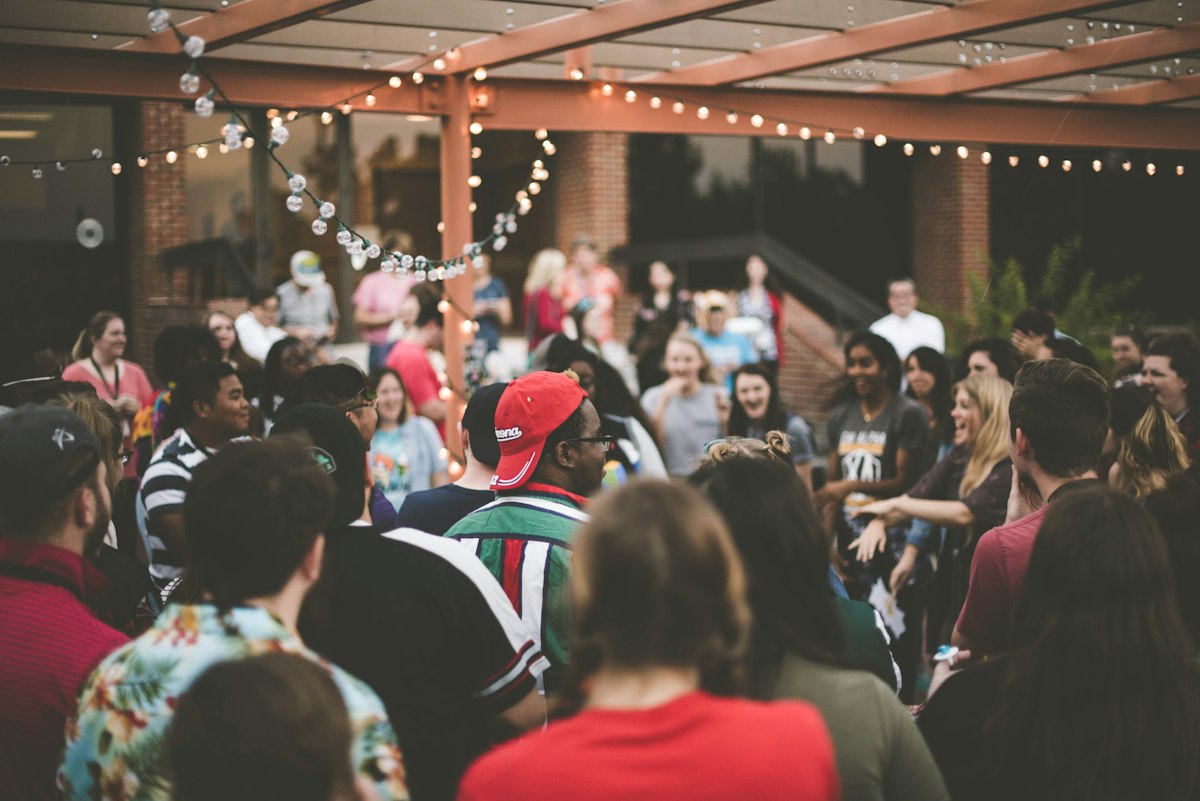
Community events — dinner clubs, local meetups, volunteer days, classes, run clubs — are tailor-made for this. They create exactly the conditions that weak ties need to form: you see familiar faces repeatedly, you share an experience, and you interact in a setting relaxed enough for genuine conversation.
You do not attend a community dinner expecting to make a best friend that evening. But you might sit next to someone who mentions a walking group you did not know existed, or who works in a field you have always been curious about, or who knows someone looking for exactly the skills you have. Each event deposits a handful of new acquaintances into your social world, quietly expanding what is available to you.
Cultivating Your Acquaintances
Most advice about adult friendship focuses on deepening your close relationships, and that matters. But there is real value in tending to the wider network too. A few small shifts can make a significant difference.
Remember names and details. Recalling something from your last conversation — even something small — signals that you actually see someone. That's how a stranger becomes an acquaintance, and an acquaintance becomes someone who might one day become more. If you want the full roadmap, read our guide on turning acquaintances into real friends.
Say yes to the unfamiliar. The events most likely to generate weak ties are outside your usual routine. A different class, a new venue, a community gathering you would not normally attend. Novelty is where new connections live.
Be a connector. When two of your acquaintances might get along, introduce them. It costs you nothing and it strengthens your own network naturally.
Show up consistently. The mere exposure effect tells us that the more often people see you, the more they tend to like and trust you. Going to the same group every week does more for your social life than popping into a dozen different ones.
What the newest research adds
Granovetter's original theory is now over fifty years old, but far from fading into academic history, it continues to be validated and extended by new research.
The most significant recent contribution came from a landmark experiment published in Science, five years of randomised experiments run inside LinkedIn's recommendation algorithm and covering some 20 million users. The researchers were able to move beyond correlation and establish a causal link: weak ties genuinely increase job mobility. But the study also revealed something more nuanced, and the relationship is not a simple straight line. Measured by mutual connections, the effect follows a curve — ties sharing about ten mutual contacts helped most, and both closer and more distant ties helped less. Measured by how much two people actually talk, the least-contacted ties helped most of all. Which measure you use changes the answer.
A 2025 study in Communications Psychology interviewed 95 autistic people and their families, most of them in Australia, about lockdown. They deeply missed not just their close relationships but their "incidental social contact" — the barista who knew their order, the fellow gym-goer they nodded to, the neighbour they exchanged a few words with at the bins. That is a striking finding about a group often assumed not to want casual contact at all: these micro-interactions were providing a sense of belonging that was only recognised once it was gone.
Meanwhile, a 2023 review in Social and Personality Psychology Compass by Sandstrom and colleagues gathered the evidence on "minimal social interactions" — the briefest of exchanges with acquaintances and strangers — and found that weak ties are a real and under-recognised source of social support, including when people are going through something hard.
Robin Dunbar's social brain research, now backed by a 2024 meta-analysis of 23 studies of personal networks and communities, with a median study size of 5,457 people, describes our social world as a series of nested layers: roughly 5 intimate friends, 15 close friends, 50 good friends, 150 meaningful connections, and 500 acquaintances. A 2025 study in PLOS ONE found that people allocate energy very differently across these layers — and that personality traits like conscientiousness shape whether you invest more heavily in your inner circle or your broader network.
This research has practical implications. If you have been feeling that your world is getting smaller — the same opinions, the same routines, the same conversations — the answer may not be deeper heart-to-hearts with your closest friends. It may be getting out of your usual environment and putting yourself in rooms where you will encounter new faces. A social dining event, a community class, a local volunteering opportunity — these are all weak-tie generators, and the science says they matter far more than most people realise.
The Acquaintance-to-Friend Pipeline
There is something else worth saying. Weak ties are valuable on their own, but they are also the raw material from which deeper friendships get built.
Every close friend you have was once an acquaintance. Every meaningful relationship began with a first conversation, a moment of mutual recognition, and a gradual deepening over time. Jeffrey Hall's research at the University of Kansas, published in the Journal of Social and Personal Relationships in 2019, mapped this progression: roughly 50 hours to move from acquaintance to casual friend, 90 hours to reach proper friend territory, and over 200 hours for a close friendship. Hall's own caveat is worth keeping — hours spent working alongside someone count for much less than leisure hours.
The challenge after 30 is not that you have forgotten how to make friends. It is that you have fewer situations generating the acquaintances who could become friends. Your pipeline has dried up. This is especially true for former colleagues who drift apart once the workplace connection fades.
Community events refill that pipeline. Each dinner, each gathering is an opportunity to meet someone new — and occasionally, to discover that a person you have been chatting with casually for months is someone you genuinely want to know better. You do not need to force it. You just need to keep showing up and let the natural process of human connection do what it has always done.
Start Expanding Your Circle
The research is clear: a rich social life is not built on close friendships alone. It is built on a diverse network that includes the people you know well, the people you know a little, and the people you are yet to meet.
If your world has been feeling small lately — the same routines, the same faces, the same conversations — the fix might not be a deeper heart-to-heart with your best friend. It might be something simpler. Walk into a room where you do not know everyone. Strike up a conversation with the person next to you. Show up to something new and see who you meet. What you really need is not just friends but a broader support network, not just a social circle.
Your next opportunity, your next perspective shift, your next friendship might come from the person you least expect. Browse our upcoming events and put yourself in the room.