
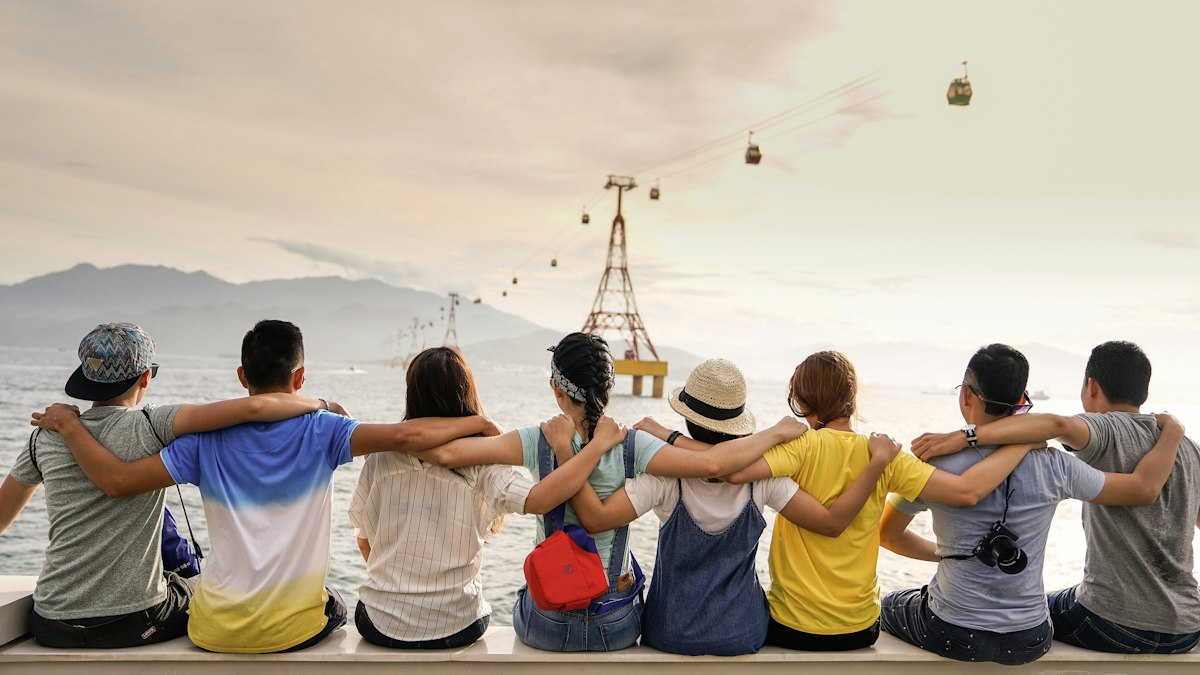
You probably have people in your life you'd call friends. People you enjoy spending time with, people who make you laugh, people you'd happily invite to a barbecue or a night out. That's your social circle, and it matters.
But here's a question that might give you pause: if everything fell apart tomorrow — a health scare, a job loss, a family crisis — how many of those people could you actually call at two in the morning? How many would show up with no notice, no judgement, and no agenda?
That's the difference between a social circle and a support network. And for most of us, the gap between the two is wider than we'd like to admit.
The Gap Between Fun Friends and Load-Bearing Friends
Let's be honest about something. Modern social life in the UK is pretty good at producing acquaintances and activity partners. We're reasonably good at knowing people. We're significantly less good at knowing people deeply.
YouGov's 2021 friendship study, of 2,195 UK adults, found that 7% of Britons don't have a single person they'd call a close friend. Another 12% have exactly one. And 41% put their number of close friends at two or three — meaning a slim majority of the country has three or fewer. That's not a crisis of socialising; most people have plenty of people around them. It's a crisis of depth.
The Community Life Survey 2024/25 paints an interesting picture of England: 94% of adults agree that if they needed help, there are people who would be there for them. But dig deeper and the picture shifts. When researchers measure indirect loneliness — the subtler feeling of lacking companionship, feeling left out, feeling isolated — 9% of adults score high, rising to 11% of 25 to 34-year-olds and 12% of 16 to 24-year-olds.
There's a gap between believing someone would help you and actually having someone you'd ask. Between having a contacts list full of names and having someone who knows what you look like when you cry.
The Community Life Survey 2024/25 found that while 92% of adults in England agree that "if I wanted company or to socialise, there are people I can call on", indirect loneliness is highest in the 16 to 49 age range — suggesting that having a social life and feeling genuinely supported are not the same thing.
Why Diverse Networks Are Stronger Networks
Here's something that might seem counterintuitive: the most resilient support networks aren't necessarily the ones with the closest friends. They're the ones with the most variety.
A 2024 study in Psychological Science, led by Miguel Ramos at the University of Birmingham, looked at the networks of 24,726 adults across more than 10,000 English neighbourhoods and found that networks spanning different ages, ethnicities, incomes and education levels are associated with greater social cohesion and wellbeing. Worth noting the nuance: the relationship is an inverted U rather than a straight line, so the finding is not "the more different everyone is, the better" — it's that a network made entirely of people like you leaves something on the table. It's about having people who bring different perspectives, different strengths, and different kinds of support.
Think about it practically. Your best friend from university might be brilliant at emotional support but rubbish at practical help because she lives 200 miles away. Your neighbour might not be someone you'd confide in about your marriage, but she'd absolutely feed your cat and collect your post without being asked. Your colleague might not know your deepest fears, but he understands your professional world in a way nobody else does.
This is what sociologists call "network diversity," and it's protective in ways that having three very close friends simply isn't. When one part of your network is unavailable — because they're going through their own crisis, or they've moved, or the context that connected you has changed — other parts can absorb the load.
The largest study of this to date is American rather than British — Raj Chetty and colleagues in Nature in 2022, built on 21 billion Facebook friendships covering most US adults aged 25 to 44 — but the finding is hard to ignore. Economic connectedness, meaning friendships that bridge income levels, was strongly associated with upward mobility where other kinds of social capital were not. The authors estimated that children from low-income families would see their adult incomes rise by around 20% if they grew up somewhere as well connected across class lines as their better-off peers do. Diverse networks don't just feel good. They appear to change outcomes.
The layers you need
A robust support network isn't a single circle. It's more like a series of concentric rings, each serving a different function.
Your inner circle (around five people). Robin Dunbar's work describes social networks as a series of layers with a typical capacity — roughly five intimates, fifteen close friends, fifty good friends, a hundred and fifty meaningful contacts. That is a description of what people's networks tend to look like, not a target to hit. Your innermost layer is the people who know everything. The ones you call in a crisis. The ones who've seen you at your worst and stayed. These relationships are built on years of trust, vulnerability, and reciprocity. You can't manufacture them quickly, but you can nurture them intentionally.
Your reliable middle ring (5-15 people). These are good friends — people you see regularly, trust with personal information, and genuinely enjoy. They might not be your first call in an emergency, but they'd step up if you asked. These friendships provide consistent companionship, practical support, and a sense of belonging.
Your wider community (15-50+ people). Neighbours, colleagues, fellow members of clubs or groups, people you see regularly at the gym or the school gate. These are the "weak ties" that sociologist Mark Granovetter wrote about in 1973 — he was studying how people found jobs, and found that acquaintances, not close friends, were the ones who brought in information from outside your own circle. That is why acquaintances matter more than most people realise. They provide information, casual connection, and a sense of being embedded in a community.
Your professional support. GP, therapist, financial adviser, support groups. These aren't friendships, but they're critical parts of a support network. Having professionals you trust means you're not relying on friends to fulfil roles they're not equipped for.
If your entire support network exists in a single context — all work friends, all school-gate parents, all people from one social group — your network is fragile. When that context changes (and it will), you risk losing everything at once. We've seen this play out repeatedly in how life transitions test your friendships. Diversify your connections the way you'd diversify investments.
Why We End Up With Narrow Networks
If diverse, layered networks are so valuable, why don't most of us have them?
We default to convenience. Most friendships form through proximity and repeated contact — work, school, neighbourhood. That's natural and not inherently bad, but it means our networks tend to be homogeneous. We end up surrounded by people who look like us, earn like us, and think like us. Comfortable, but not resilient.
We confuse busyness with connection. Modern life in the UK is relentless. Between work, family obligations, commuting, and the sheer admin of existing, social time gets squeezed into whatever gaps remain. And those gaps tend to be filled with the easiest, most familiar connections — not necessarily the most nourishing ones.
We've lost community infrastructure. The places where diverse connections used to happen organically — pubs, churches, community centres, social clubs — have been disappearing for decades. It turns out your neighbourhood matters more than your wider network when it comes to building these everyday ties. The National Lottery Community Fund's Community Research Index, which surveys over 8,000 UK adults, found that 72% say it is important to them to feel part of their local community — and that among those who do feel part of one, the most commonly named benefit was simply having an opportunity to meet people (45%).
We underestimate weak ties. British culture tends to valorise deep, intimate friendship and dismiss everything else as superficial. But the research is clear: weak ties matter enormously. The person you chat to at the coffee shop, the neighbour you nod to every morning, the acquaintance you see at a monthly dinner — these connections provide a sense of belonging that close friendships alone can't replicate.
Practical Steps to Build Layers of Connection
Building a support network isn't about collecting people. It's about intentionally creating connections across different parts of your life so that when one area shifts, you're not left stranded. Here's how to do it practically.
Audit what you already have
Before you start building, take stock. Who are your inner circle people? Who sits in your middle ring? Where are your weak ties? And crucially — where are the gaps? If all your friends are from work, you're vulnerable to a job change. If all your support comes from one person, you're putting unsustainable pressure on that relationship.
Show up to something regularly
The single most effective way to build new connections is repeated, low-pressure contact over time. Join something that meets regularly — a running club, a book group, a community dinner, a volunteering project. Research from the University of Kansas found it takes roughly 50 hours of shared leisure time to move from acquaintance to casual friend, around 90 hours to become proper friends, and more than 200 hours before someone counts as a close friend. Hours spent working alongside someone barely count. You can't shortcut that. But you can create the conditions for it by being somewhere consistently.
Bridge across contexts
Deliberately seek out connections in areas of your life where you don't currently have them. If your friends are all your age, find something intergenerational — mixing generations is one of the few network changes that reliably gives both sides something the other hasn't got. If your friends all share your background, look for spaces that attract a mix. If your social life is entirely online, find something face-to-face.
Invest in your weak ties
Stop treating casual connections as lesser. The barista who knows your order, the dog walker you see every morning, the person you always end up chatting to at events — these relationships deserve acknowledgement and nurturing. A simple "fancy grabbing a coffee sometime?" can turn a weak tie into something more. And even if it doesn't, the sense of community those connections provide is genuinely protective against loneliness.
Deepen the friendships that matter
It's not enough to have people around you. You need some of them to know you properly. That means being willing to be vulnerable — to share something real, to ask for help, to admit when you're not okay. Depth in friendship isn't something that happens to you. It's something you choose, every time you decide to be honest rather than polished.
Don't neglect professional support
A therapist is not a replacement for friends, and friends are not a replacement for a therapist. Build both. Having a professional you can turn to means you're not dumping emotional weight on friends who aren't trained to carry it, and it means you have somewhere to go when your personal network is stretched.
Be the support you want to receive
The fastest way to build a strong support network is to be a strong part of someone else's. Check in on people. Remember what they told you. Show up when it's inconvenient. Offer practical help without being asked. Networks are reciprocal — the more you give, the more comes back.
You don't need to overhaul your social life overnight. Start with one new thing: one regular commitment, one deeper conversation, one invitation extended. Support networks are built slowly, through consistent small choices — not through dramatic reinvention.
The Difference a Network Makes
When life gets hard — and it will — the people who weather it best aren't the ones with the most friends. If you're navigating uncertainty right now, you might also find comfort in our piece on finding your people when everything feels unstable. They're the ones with the right mix: someone to talk to, someone to help with the practical stuff, someone who makes them laugh, someone who connects them to opportunities, and a community that makes them feel they belong somewhere.
That mix doesn't happen by accident. It happens because someone decided, at some point, that connection was worth investing in. That showing up to a dinner with strangers was worth the awkwardness — and understanding how it works makes the first step easier. That being honest with a friend was worth the vulnerability. That building something new was worth the effort.
The research backs this up. Diverse, layered networks are associated with better mental health, greater resilience during crises and better physical health — and the largest meta-analysis of the mortality question, covering 148 studies and around 308,000 people, found that those with stronger social relationships had a 50% greater likelihood of surviving the study follow-up periods. This isn't soft advice. It's one of the most evidence-backed strategies for living a good life.
Building a support network starts with a single decision to show up somewhere new and let yourself be known. You don't need to arrive with a plan. You just need to arrive.