
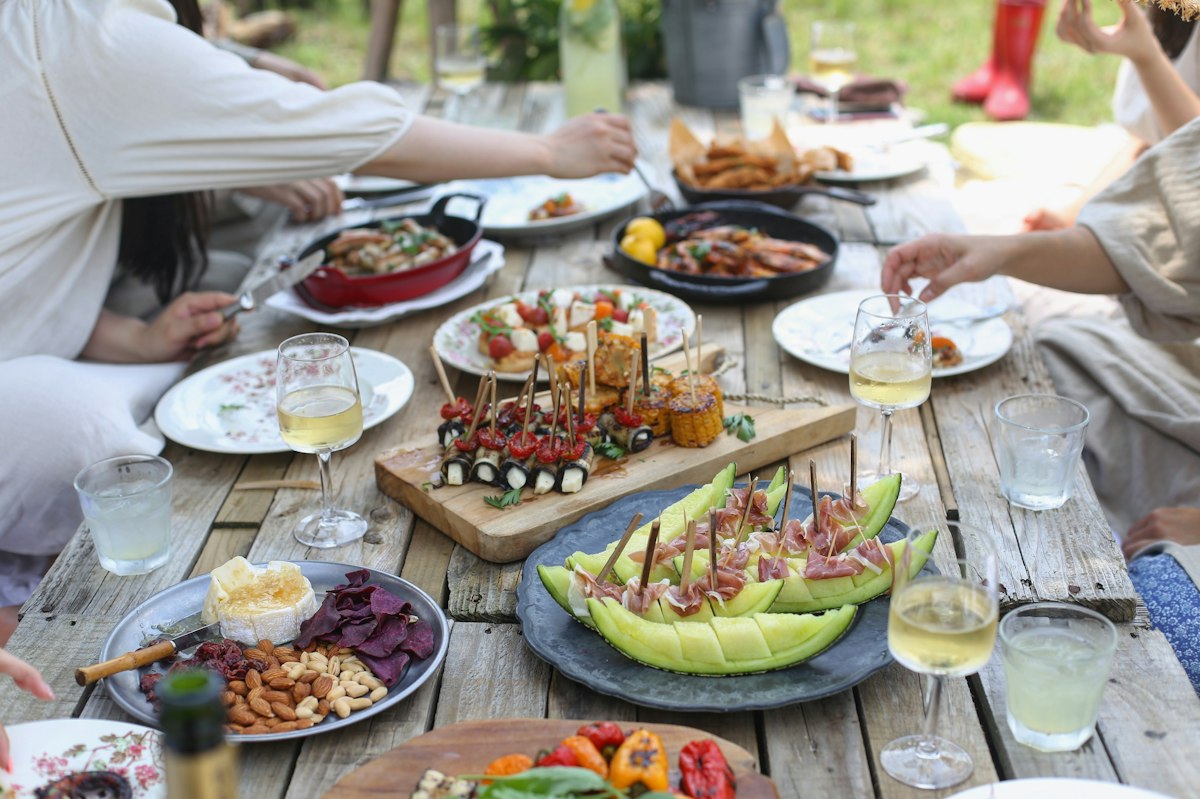
One Day, One Meal, Millions of People
Every year on the first weekend of June, something remarkable happens across Britain. Streets get closed off. Trestle tables appear on pavements. Neighbours who've lived side by side for years without exchanging more than a nod find themselves passing plates of sandwiches and slices of cake to one another. Children run between gardens. Someone brings a speaker. Someone else brings a pot of chilli that's far too large for one family.
This is the Big Lunch — and in 2025, over 10 million people took part.
The idea is disarmingly simple: share a meal with your neighbours. No tickets. No formal programme. No requirement beyond showing up with something to eat and a willingness to talk to the person next to you. The Eden Project launched the initiative in 2009, and it has brought people out onto their streets every summer since — more than six million a year on average.
Eden Project Communities publishes an impact report each year, and its own summary of the 2025 weekend is that people came away feeling safer, less lonely and more connected to where they live. We have deliberately not printed the finer-grained percentages that circulate about the Big Lunch, because we could not trace any of them back to a published report.
In a country where 6.6% of adults in England say they feel lonely often or always — rising to 9% of 16 to 24 year-olds — the power of a shared meal on a blocked-off street is hard to overstate.
The Science Behind Communal Eating
The Big Lunch works because it taps into something ancient. Professor Robin Dunbar, the Oxford evolutionary psychologist whose work on social networks has shaped how we understand human relationships, studied the Big Lunch specifically — and his findings were striking.
Dunbar's research, published in 2017 in Adaptive Human Behavior and Physiology as Breaking Bread: the Functions of Social Eating, found that communal eating increases social bonding and feelings of wellbeing, and enhances one's sense of contentedness and embedding within the community. People who eat socially are more likely to feel better about themselves and to have a wider social network capable of providing emotional support.
Crucially, his path analysis suggested that the causal direction runs from eating together to bondedness — not the other way around. In other words, it's not just that bonded people eat together. The act of eating together actively creates the bond.
Research from the University of Oxford found that the causal direction runs from eating together to feeling bonded — not the other way around. Sharing a meal doesn't just reflect closeness. It creates it.
The mechanism, Dunbar argues, is evolutionary. Communal eating may have evolved specifically as a mechanism for social bonding in early human groups. The meals that produce the strongest bonding effects involve more people, more laughter, more reminiscing, and — perhaps unsurprisingly — the occasional glass of wine. Evening meals were particularly effective.
This is why sharing a meal can genuinely change your social life. It's not a metaphor. It's neurochemistry.
How the Big Lunch Actually Works
The Big Lunch 2026 ran from Friday 5 to Monday 8 June — a four-day window that gives communities flexibility to hold their events on whichever day works best. It was again paired with The Big Help Out, making a combined weekend of food, friendship and volunteering that coincides with Volunteers Week. The next one falls on the first weekend of June, and Eden Project Communities publishes the exact dates each year.
Anyone can organise a Big Lunch. The Eden Project Communities website provides free resources — planning guides, invitations, recipes, activity packs — and the format is entirely flexible. Some streets go all out with bunting, live music, and a dozen dishes. Others keep it simple: a few chairs on a front garden, some homemade biscuits, and a kettle.
What they all share is the same underlying principle: when you eat together, barriers come down. Read through the community stories Eden publishes and the same things keep coming up — neighbours meeting for the first time after years on the same road, older residents and young families ending up at the same table, streets that had nothing in common finding they did. These aren't politically motivated gatherings. They're sandwiches on a trestle table. And somehow, that's enough.
Beyond the Big Lunch: The Community Meal Movement
The Big Lunch is the most visible example of community eating in the UK, but it's far from the only one. A quiet ecosystem of organisations has been building the infrastructure for shared meals year-round.
FoodCycle
FoodCycle runs free community meals across England and Wales, made entirely from surplus food that would otherwise go to waste. Volunteers collect ingredients from local supermarkets and businesses, cook them up at community venues, and serve meals that are open to everyone — no questions asked, no means testing, no booking required.
The model is elegant in its simplicity: it tackles food waste, hunger, and loneliness simultaneously. FoodCycle describes itself as being about "more than food" — creating a cycle of positive change that supports mental health, encourages healthy eating, and builds community connections.
In Exeter, FoodCycle runs a weekly community meal at the Mint Methodist Church on Fore Street, on Tuesday evenings from 6.30pm. Anyone can turn up. It's one of the most accessible ways to experience communal eating in Devon — but projects do move venues, so check the FoodCycle Exeter page before you go.
Community Fridges
Exeter has also become a quiet leader in the community fridge movement. The city's community fridges redistribute surplus food for free, no questions asked. In just over a year, the fridge at Exeter Central Library alone redistributed over 5,000 kilograms of food, equivalent to around 12,000 meals.
The St Thomas Community Fridge, coordinated by Love Food CIC, is believed to be one of the only vegan community fridges in the UK. It started in St Thomas Library and has since moved to the group's own food hub at 95 Cowick Street, open Monday to Thursday, 10am to 3pm.
What makes community fridges relevant to this conversation isn't just the food — it's the culture they create. When a neighbourhood rallies around the idea that food should be shared rather than wasted, it shifts something in how people relate to one another. The fridge becomes a meeting point. A conversation starter. A reason to stop and talk.
Community fridges and larders have spread right across Devon over the last few years. Recycle Devon keeps the current list, which is the place to look for one near you.
Casserole Club
Casserole Club takes community meals to the most intimate level: one cook, one neighbour, one plate of food. The idea, which started in Surrey in 2011, is that people who enjoy cooking make an extra portion of whatever they are already preparing and drop it round to a neighbour — often older or unwell — who can't easily cook for themselves. The meal is free. What it really buys is ten minutes of conversation at the door, week after week.
Worth being straight about the state of it, though: the national Casserole Club platform is gone — its website no longer resolves. What survives is local. In Brighton and Hove the scheme still runs, as a partnership between Together Co and the Brighton and Hove Food Partnership. We have not found a Devon equivalent. If you want to do this here, the honest answer is that it currently means doing it informally, for the neighbours you actually have.
From FoodCycle's community meals to a neighbour dropping a plate of food round, the UK has built an extraordinary grassroots infrastructure for sharing food. The common thread? Food is never just food. It's connection.
Devon's Community Food Scene
Devon punches well above its weight when it comes to community food initiatives. Beyond FoodCycle and the community fridges, the county has a rich ecosystem of projects bringing people together around food:
Food Exeter coordinates community food hubs across the city, connecting local projects that offer everything from cooking lessons and "cook along" events to affordable food clubs and community allotments. Their work recognises that food insecurity and social isolation are deeply intertwined — and that addressing one often helps with the other.
The Benita Project in South Molton made headlines during the 2025 Big Lunch by hosting a two-course "friendship meal" as part of its mission to combat social isolation and food poverty. The name tells you everything about the philosophy: these aren't charity meals. They're friendship meals.
The Love Local Food Festival, run by Greendale, brings producers, street food traders and the community together at Exeter Castle each August — free to enter, no ticket needed, and exactly the kind of casual, shared experience that builds belonging.
These aren't isolated projects. They're part of a growing recognition that communities are healthier, safer, and happier when people eat together regularly.
What Community Meals Teach Us About Eating With Strangers
There's a lesson in the Big Lunch that applies far beyond street parties.
The fundamental insight is this: you don't need to know someone to share a meal with them. The meal itself is the introduction. The food is the common ground. And the act of sitting down together — even awkwardly, even nervously — creates the conditions for connection that no amount of swiping, messaging, or small talk at a networking event can replicate.
This is exactly the principle behind Dinners With Friends. If an entire street can shut down for an afternoon and break bread with neighbours they've barely spoken to, then a table of eight people at a restaurant in Exeter can do it too. The scale is different. The mechanism is the same.
Dunbar's research is unambiguous on this point: 76 per cent of the people he surveyed said they believed sharing a meal was a good way to bring people closer together. And yet, one in eight said it had been more than six months since they'd shared a lunch with friends or family. We know communal eating works. We're just not doing it enough.
The Loneliness Gap — And How to Close It
Community meal initiatives like the Big Lunch are powerful because they lower every barrier to entry. You don't need to buy a ticket. You don't need to dress up. You don't need to know anyone. You just need to walk outside your front door.
But the Big Lunch happens once a year. FoodCycle runs weekly in some locations but not all. Community fridges are growing but still patchy. The infrastructure for communal eating in Britain is expanding, but it's not yet woven into the fabric of everyday life the way it needs to be.
That's where intentional social dining fills the gap. Events like ours exist because the need for regular, low-pressure, food-centred social gatherings extends well beyond one weekend in June. The people who come to Dinners With Friends often describe the same feeling that Big Lunch participants report: surprise at how easy it was, relief at how natural the conversation felt, and a quiet thrill at having made a genuine connection with someone they didn't know that morning.
If an entire street can share a meal with neighbours they've barely spoken to, then a table of strangers at a restaurant can do it too. The scale is different. The mechanism is the same.
The Big Lunch proves something important: British people want to eat together. They want to know their neighbours. They want to feel part of something. The appetite is there — it just needs a table to sit at.
How to Get Involved
If the idea of community meals resonates with you, here's where to start:
Organise a Big Lunch. It lands on the first weekend of June each year — 2026's ran from 5 to 8 June. Visit the Eden Project Communities website for the next dates and for free resources and planning guides. It doesn't have to be elaborate — a cup of tea and a plate of biscuits on your front step counts.
Volunteer with FoodCycle. If you're in Exeter or elsewhere in England and Wales, FoodCycle is always looking for volunteers to help cook, serve, and collect surplus food. No experience required — just a willingness to chop, stir, and chat. Find your nearest project at foodcycle.org.uk.
Visit a community fridge. Check Recycle Devon's listings for community fridges and larders near you. Take food, leave food, or just see what's there. The point is participation.
Build your own social calendar. The research is clear: regular communal eating — whether it's a weekly FoodCycle meal, a monthly supper club, or a standing Wednesday dinner with friends — has measurable benefits for your mental health, your sense of belonging, and the strength of your social connections.
The table is set. The food is ready. All that's missing is you.