
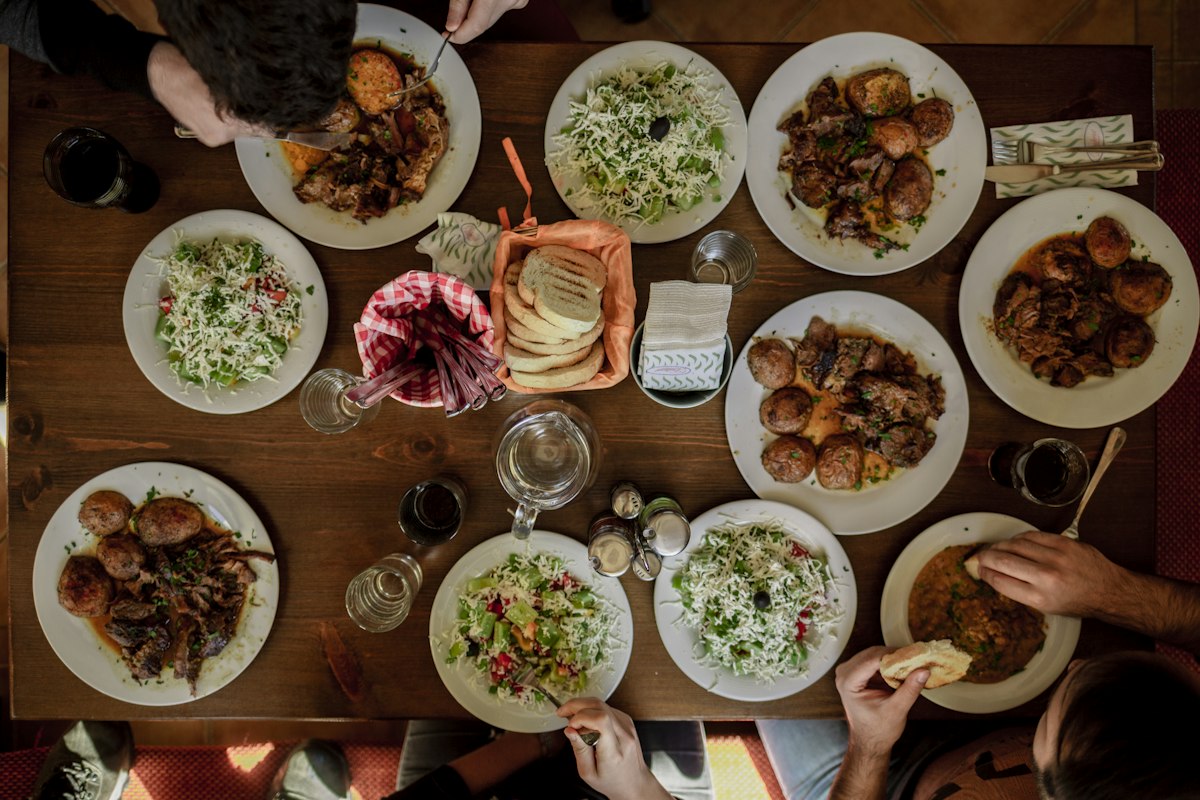
The First Classroom
Long before we entered a school, most of us learned our most important social lessons at a table. We learned to wait our turn. We learned to say please and thank you. We learned that other people have needs and preferences that are different from our own, and that those needs matter. We learned to share, to listen, to sit still, and to be part of something larger than ourselves.
None of this was taught in a formal sense. There was no curriculum, no assessment, no lesson plan. It happened organically, embedded in the daily ritual of sitting down to eat with other people. The dinner table was — and for many families still is — the first and most important classroom of social life.
What makes the dinner table such a remarkable teacher is that it does not feel like teaching. A child who is asked to pass the potatoes is not being drilled in cooperation. They are simply participating in a meal. But the cumulative effect of thousands of these small acts — passing, waiting, thanking, listening, contributing — is the development of a social being. A person who understands, at a deep and instinctive level, how to live alongside others.
The question is: what happens when we lose that classroom?
What the Research Tells Us
The evidence for the power of family meals is extraordinary in both its depth and its consistency.
Harvard's Family Dinner Project, based at the university's Project Zero research centre and founded in 2010, has spent over fifteen years studying the effects of regular family mealtimes. Their findings are striking. Children who eat regularly with their families show higher academic achievement, greater resilience, and stronger self-esteem. They have healthier relationships with food and lower rates of disordered eating. Perhaps most remarkably, 80 percent of teenagers say that family dinner is the time of day they are most likely to talk to their parents.
Eighty percent. In an era when parents routinely worry about the impossibility of communicating with their adolescent children, the answer has been sitting in front of them all along. It is the dining table.
The Columbia University CASA studies, conducted over more than a decade by the National Center on Addiction and Substance Abuse, found that teenagers who eat dinner with their families five or more times a week are four times less likely to smoke, two and a half times less likely to use marijuana, and half as likely to drink alcohol compared to those who eat with family twice a week or less. These are not marginal differences. They are transformative ones.
Harvard's Family Dinner Project found that 80 percent of teenagers say family dinner is the time of day they are most likely to talk to their parents. The dinner table is not competing with technology for children's attention — it is winning, when we give it the chance.
But the benefits extend far beyond risk prevention. The American College of Pediatricians has documented that children who eat with their families regularly develop stronger social-emotional skills, fewer behavioural problems at school, more confidence in peer relationships, and a greater sense of being valued and understood by their parents. The dinner table, they conclude, is one of the most significant protective factors in child development.
The mechanism is not mysterious. The family table is one of the very few places where children can observe their parents interacting, negotiating, solving problems, expressing emotions, and treating each other with respect. A child's world is mostly spent with peers and teachers. The dinner table gives them a front-row seat to how adults cooperate, disagree, repair, and connect.
The Rules Nobody Writes Down
Every dinner table has rules. Most of them are never formally stated. They are absorbed through repetition, modelled by the adults present, and enforced through gentle correction rather than explicit instruction. Yet these unwritten rules constitute one of the most comprehensive social curricula any of us will ever encounter.
Waiting Your Turn
At the dinner table, you cannot all talk at once. You learn to listen while someone else is speaking, to hold your thought until there is a natural pause, and to gauge when it is appropriate to contribute. This is not just table manners. It is the foundation of every productive conversation, every functional meeting, every healthy relationship you will ever have.
Sharing and Generosity
You serve others before yourself. You offer the last piece before taking it. You notice when someone's glass is empty. These small acts of generosity are so routine at a well-run dinner table that they barely register as remarkable. But they are training a fundamental orientation toward others — the habit of noticing what someone else needs and responding to it without being asked.
Gratitude
Whether it takes the form of grace before a meal, a simple thank-you to the cook, or the Japanese tradition of saying itadakimasu — "I humbly receive" — before eating, virtually every dining culture in the world includes some expression of gratitude. This is not mere politeness. It is a recognition that food has been grown, prepared, and shared by others, and that this generosity deserves acknowledgement.
Presence and Attention
The dinner table asks you to be here, now, with these people. Not scrolling, not distracted, not planning your next move. The table demands a quality of attention that is increasingly rare in modern life, and it rewards that attention with something screens cannot provide: genuine human connection.
Navigating Difference
Not everyone at the table likes the same food, holds the same opinions, or has had the same kind of day. The dinner table teaches you to coexist with difference — to eat something you did not choose without complaint, to listen to a perspective you do not share without hostility, to accommodate someone else's needs without resentment. These are sophisticated social skills, and we learn them before we are old enough to name them.
Table Rules Across Cultures
What is remarkable about dinner table traditions is not their diversity but their consistency. Across vastly different cultures, the same core values appear again and again: hospitality, generosity, respect, gratitude, and the primacy of community over the individual.
In Ethiopian dining, the communal nature of the meal is built into the food itself. Dishes are served on injera, a large spongy flatbread that functions as both plate and utensil. Everyone eats from the same bread, tearing off pieces to scoop up shared stews and salads. The act of gursha — hand-feeding someone else a morsel of food as an expression of love and respect — takes the principle of sharing to its most intimate conclusion.
In Korean dining culture, the eldest person at the table eats first, and younger diners pour drinks for their elders as a gesture of honour. The meal is not just about food; it is a performed expression of social hierarchy, care, and mutual obligation.
In Spain, mealtimes are built around sobremesa — the time spent lingering at the table after the food is finished, talking, laughing, and simply being together. There is no rush to clear the plates. The conversation is considered as important as the meal itself, and cutting it short would be considered poor form.
In Japan, the meal begins with itadakimasu and ends with gochisousama deshita — "thank you for the feast." These phrases bookend the meal with gratitude, creating a deliberate frame around the act of eating that elevates it from biological necessity to social ritual.
Even in Britain, where we sometimes claim to have no dining culture, we have deeply embedded table traditions. The Sunday roast. The ritual of tea and biscuits. The expectation that the host will not eat until their guests have been served. The universal understanding that elbows do not belong on the table. These are not arbitrary rules of etiquette. They are the social glue of a culture, passed down through the simple, daily act of eating together.
You do not need to adopt another culture's dining traditions to benefit from this wisdom. Start by naming the values your own table represents. If you cook for friends, you are practising generosity. If you listen while someone talks, you are practising patience. If you say thank you for the meal, you are practising gratitude. The table already teaches — you just need to notice.
The Cost of Losing the Table
The statistics on declining family meals in Britain are sobering. Research by Sainsbury's found that family dinnertime is falling year on year. Studies show that Britons eat four breakfasts, four lunches, and two evening meals alone on average in a typical week. Over a third of people can go an entire week without eating alongside another person. Those aged over 55 are most likely to eat alone — one in four in this age group said an evening meal with others was not a usual occurrence.
The reasons are structural. Longer working hours. Shift patterns that fragment family schedules. Smaller households. The rise of food delivery designed for individual consumption. The gravitational pull of screens. The United Kingdom now ranks 81st out of 142 countries for shared meals.
But the consequences are personal. When we lose the dinner table, we lose the primary space in which social values are transmitted, practised, and reinforced. We lose the place where children learn empathy, where couples reconnect, where families process the events of the day, and where friendships deepen beyond the superficial.
Robin Dunbar's research at Oxford makes the connection explicit. Those who eat socially more often feel happier, are more trusting of others, are more engaged with their local communities, and have more friends they can depend on for support. His work found that the causal direction runs from eating together to social bondedness, not the other way around. It is not that happy, well-connected people eat together more. It is that eating together makes people happier and better connected.
As we explored in The Dinner Table as Sanctuary, the shared meal triggers the brain's endorphin system — the same neurochemical pathways activated by laughter, singing, and physical touch. The dinner table is not just a metaphor for connection. It is a mechanism for it, built into our neurobiology.
When we abandon the table for the sofa, the desk, or the bedroom, we do not just change where we eat. We change how we relate to each other.
What We Lose When Children Eat Alone
The effects on children are particularly concerning. Research published by the American College of Pediatricians found that the family table is one of the very few places where children can observe adults modelling healthy social behaviour — negotiating, expressing emotions, resolving conflict, and showing care.
Children who eat with their families develop what researchers call a "social template" — an internal model of how relationships work. They learn that disagreements happen and can be resolved. They learn that feelings can be hurt and repaired. They learn that someone else's bad day deserves attention and compassion. These lessons are not taught explicitly. They are absorbed through participation.
Children who miss out on regular family meals are more likely to experience social-emotional difficulties at school, show less confidence in peer relationships, and struggle with the basic mechanics of conversation — turn-taking, listening, responding to social cues. These are the same skills that adults later identify as the foundations of good friendships, strong marriages, and effective professional relationships.
The irony is that parents who are too busy to sit down for family dinner are often busy precisely because they are trying to provide their children with advantages — extracurricular activities, tutoring, enrichment programmes. But the research consistently shows that the dinner table provides something none of these structured activities can replicate: an unscripted, unhurried space for practising what it means to be a social human being.
Britons eat nearly half their weekly meals alone. Over a third can go an entire week without sharing a meal with another person. The dinner table — humanity's oldest classroom for social values — is being abandoned at the very moment we need it most.
Rebuilding the Table
If you did not grow up with regular family dinners, or if your current life does not easily accommodate them, the good news is that the benefits of shared meals are available to anyone willing to create the conditions for them.
The dinner table does not require a dining room, matching crockery, or a family in the traditional sense. It requires a surface, some food, and the deliberate decision to eat with other people, without distraction, with attention and care.
For those living alone, this might mean hosting a friend once a week. Or joining a supper club. Or simply eating lunch with a colleague instead of at your desk. Robin Dunbar's research showed that any form of social eating triggers the bonding mechanisms — it does not need to be a formal dinner with candelabra and a seating plan.
For parents, the research is clear: aim for five shared family meals a week. That is the threshold at which the protective effects become most pronounced. They do not need to be elaborate. Toast and scrambled eggs, eaten together at the kitchen table with the television off, delivers the same benefits as a three-course roast.
For anyone who feels they have lost the art of table conversation, the skills come back quickly. Start by asking genuine questions. Put the phones away — physically away, not face-down on the table. Let silences happen without rushing to fill them. And be willing to share something real about your own life, because vulnerability at the dinner table is contagious in the best possible way.
The values that the dinner table teaches — patience, generosity, gratitude, attention, the willingness to share and to listen — are not old-fashioned or irrelevant. They are the exact skills that modern life is making harder to practise and more essential to have. Every meal shared with intention is a small act of restoration, a way of reconnecting with the social foundations that make us who we are.
The Table We Build for Each Other
At Dinners With Friends, we see this every time a group sits down together. People arrive as strangers and leave as something more. Not because the food was extraordinary or the venue was special, but because the table did what tables have always done: it arranged people face to face, gave them something to share, and created the conditions for real conversation.
The dinner table is not a relic of a simpler time. It is a technology — the most important social technology ever invented — and it works every time we choose to use it. It teaches children how to be social beings. It teaches adults how to maintain their humanity. It teaches all of us, every time we sit down and break bread together, that we are not meant to eat alone.
The role of food in emotional wellbeing goes far beyond nutrition. Food is the medium through which we express care, build trust, and create the shared rituals that hold communities together. The rules of the dinner table are not constraints. They are invitations — to slow down, to pay attention, to be generous, and to remember that the most important thing on the table is never the food.
It is the people.