Introduction: How This Happened
This book did not begin as a book. It began with women telling me they would love to meet a man.
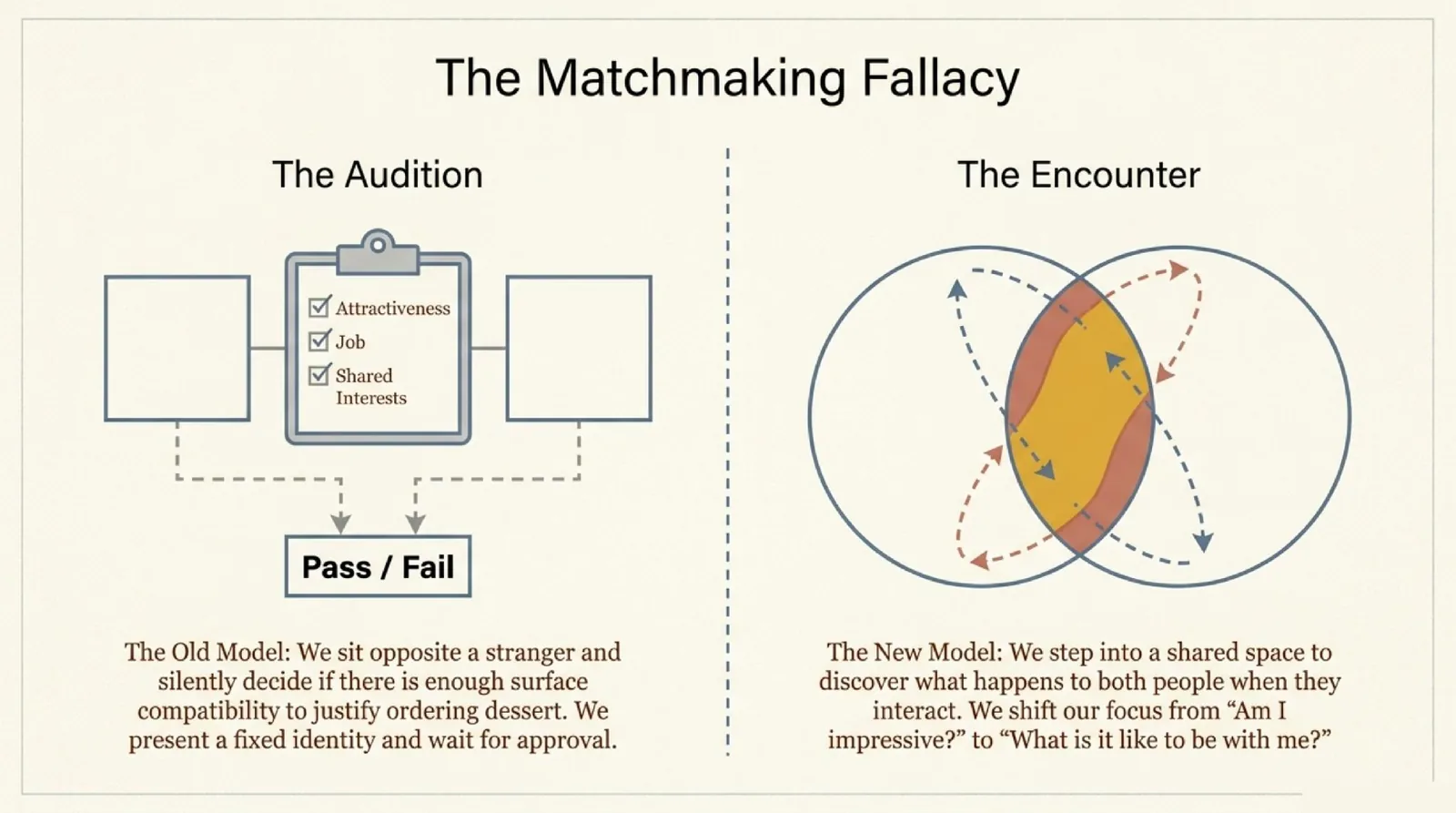
Not necessarily any man. Most of them had already learnt the dangers of that approach. They wanted companionship, affection, laughter and somebody with whom they might share the life they had spent years building. They wanted to meet someone, but many had grown tired of dating apps, awkward introductions and the peculiar business of sitting opposite a stranger while silently deciding whether there was enough attraction to justify ordering pudding.
Every now and then, a man would tell me that he would very much like to meet a woman too. The numbers were hardly equal, but the hope was not confined to one side of the table. There were men and women who had built good lives, yet still wondered who might share them.
Because I run Dinners With Friends, I began wondering whether there might be a kinder way.
What if we brought people together in groups? There would be less pressure and no need to sustain an entire evening with one person whose most absorbing interest turned out to be motorway junctions. Nobody would have to decide within seven minutes whether they had met a future partner.
But the idea was never simply to place a selection of unattached men and women in a room and hope that romance broke out near the coffee machine. The matchmaking days were designed to help people understand themselves while they met one another.
There would be workshop scenarios, conversations and exercises completed in pairs. The pairs would change throughout the day, allowing people to interact with different personalities rather than attaching themselves immediately to the person they found most attractive. Through those encounters, participants could begin to notice how they listened, what they assumed, how they responded to uncertainty and what happened to another person in their company.
They would learn useful skills too. How to ask without interrogating. How to show interest without rushing intimacy. How to disagree without turning a conversation into a small tribunal. How to notice when nerves were making them perform, retreat or talk for nineteen uninterrupted minutes about something nobody else had asked about.
The day would end with dinner shared by the whole group. By then, people would have worked together, laughed, moved around, met several different versions of one another and, we hoped, learnt something about themselves. Dinner would not be an audition. It would be the experience that brought the day together.
It would not be speed dating, and nobody would be required to move one chair to the left every four minutes while answering a question about their ideal Sunday. It would be gentler than that. More thoughtful. More useful. More human.
Then the panic arrived.
What if only women booked?
I could already imagine the room. Thoughtful, interesting women had invested their money and arrived ready to meet someone, only to discover that ‘someone’ was another thoughtful, interesting woman who had been promised exactly the same thing.
What if the men we hoped to attract did not want to invest in something like this? It is difficult enough persuading some men to book a perfectly agreeable dinner without asking them to spend a day considering their emotional availability. The occasional man expressing an interest was encouraging. It was not yet a business model.
We could find ourselves promising an experience that depended upon equal numbers of men and women, while having very little control over whether those equal numbers appeared. We would not merely have an awkward seating plan. We would have failed to deliver what people reasonably believed they had paid for.
The problem was not the women. It was not necessarily the men either. The problem was that we had built the whole idea around who might walk through the door.
So we did not abandon the matchmaking days. We stepped back from them.
We still want to create group days for people who are genuinely interested in meeting a partner, where they can learn about themselves while getting to know other people in a relaxed and less pressurised setting. That remains part of the ambition.
We simply have not earned our wings for it yet.
Before we promise romance, balanced numbers or meaningful introductions, we need to understand what happens in the room. We need to test the exercises, listen to participants and discover what genuinely helps. We need to learn what people find valuable, what surprises them, what makes them uncomfortable in a useful way and what looks clever on paper but falls rather flat when twelve actual human beings are asked to do it before lunch.
The first Risk Someone masterclasses are that beginning. They do not depend upon equal numbers of men and women, and they do not promise that anybody will leave with a telephone number tucked into a pocket. They begin with a question that matters before matchmaking and long after it:
‘What is it like for someone to meet you?’
That question applies whether you are looking for a partner, entering a friendship, joining a workplace, living within a family or wondering why the same difficulty seems to follow you from one relationship to another. It is not a retreat from the hope of finding someone. It is preparation for what happens when we do.
The project was originally called With Someone. It was gentle, warm and perfectly respectable.
Then somebody misheard it.
‘Risk Someone?’
We corrected them. Then we stopped.
Risk Someone was much closer to the truth.
To meet another person properly is always a risk. We risk being misunderstood, disappointed, irritated or rejected. We risk revealing more than we intended. We risk discovering that somebody who looked fascinating from across the room becomes rather less fascinating during a detailed account of their dispute with the local council.
We also risk being surprised, delighted, accepted and changed.
Perhaps most uncomfortably, we risk being seen accurately. We may discover that the warmth we thought we offered felt like pressure, or that our independence looked like disinterest. We may learn that the story we tell to break the ice has been told so many times that even we are bored by the third paragraph. We may find that the people around us are doing a surprising amount of work to accommodate a habit we barely know we have.
The reverse is possible too. We may have spent years believing we are awkward, uninteresting or forgettable, while other people experience us as calming, thoughtful or wonderfully easy to talk to. Self-knowledge is not always an inventory of things that need fixing. Sometimes it is the discovery that what we thought was missing has been quietly visible to everybody else.
You may know what you intended. You may know that you were trying to be attentive, confident, amusing or considerate. But what did the other person experience?
This book will help you recognise the signals you may be sending, understand why an encounter changed direction and notice the difference between showing interest and applying pressure. It will not teach you tricks or techniques. It will help you stop guessing.
Some of what follows can be explored alone. Some of it becomes clearer in the company of other people. That is why Risk Someone also exists as a facilitated day: an opportunity to bring these ideas into a real room, try them through conversation and practical exercises, and discover how other people actually experience us. You do not need to attend a Risk Someone day to benefit from this book, but if you do, you will arrive already familiar with the questions we will explore together.
I have seen this gap between intention and experience play out repeatedly at Dinners With Friends. On one occasion, everyone at the table had finished the main course except Sebastian. He was not struggling with the food. He had simply been talking for so long that he had forgotten to eat, and the restaurant could not move us on while his plate remained virtually untouched. His sentences did not end. They merely changed the subject.
Eventually, the host in me took over.
‘Hey, Sebastian, how's it going? We're all starving down here. Eat, eat, eat!’
I said it laughingly, and everyone laughed, including Sebastian. But there was real intent beneath it. Please draw breath. Please eat your dinner. Please let us have the next course before breakfast.
He was not deliberately trying to dominate the evening. He was enthusiastic, sociable and probably thought the conversation had flowed wonderfully.
Technically, it had. Rather like a burst pipe.
Sebastian meant to contribute. The rest of the table experienced being held up. Both things could be true at once, and that is precisely the sort of small human collision this book is interested in.
That accidental title gave us the book.
A small word, too, about the people you are about to meet. Some are inspired by observations from life, some are composites and others have been created to explore a familiar human difficulty without exposing an actual person over the soup course. Details have been changed, and occasionally the names rhyme.
You will meet Chloe and Joey, Toby and Tessa, Ollie and Molly, Harry and Carrie, Dan and Fran, Ross and Rosa, and several others whose parents appear to have coordinated their choices in advance.
There is no psychological significance to this. I started doing it, amused myself and then found it difficult to stop.
It also prevents anyone from deciding that a particular character must be Derek from the dinner in Totnes. Derek, if you are reading, it probably is not you.
Probably.
The people in these pages are not examples of how to behave properly. They are not here to be corrected, diagnosed or divided into the emotionally enlightened and the socially hopeless. The women will not always be wise and the men will not always be the problem. Nobody will be awarded points for using the approved amount of eye contact, and there will be no final examination on the correct moment to ask a follow-up question.
They are simply people doing what most of us do. They arrive with good intentions, old habits, private nerves and very little idea of what it is like to encounter them from the other side of the room.
This is not a book promising to make everybody like you. That sounds exhausting, and some people are determined not to like anybody until the second cup of coffee. Nor is it a manual for performing the ideal personality. There is no ideal personality. Even the most charming person you know is too much for somebody.
It is an invitation to become curious.
What happens to people when they are with you? Do they settle, expand, compete, retreat, confess, perform or become more fully themselves? Can they disagree with you? Do they feel that you are interested in them, or merely waiting for your turn? Are you creating space, filling it or valiantly rescuing it before silence has had so much as three seconds to do its work?
You may never know yourself completely. Every person you meet encounters a slightly different version of you, and every encounter is shaped by what both of you bring into it. But you can become more alert to the patterns. You can notice the difference between what you meant to offer and what actually arrived.
You can ask a better question.
The book follows that question through three parts. The Approach begins before anything much has happened, when we are deciding whether to enter the room, what to reveal and which familiar version of ourselves to bring with us. The Encounter looks at what happens once another person is actually there, with needs, habits and interpretations of their own. The Reckoning asks what remains afterwards, what keeps repeating and what we might do differently next time.
Throughout the book, the sections called What Do I Do Now? bring the larger ideas back into ordinary life. They are not rules for becoming more appealing, and they will not require you to adopt an approved personality before leaving the house. They are pauses in which to notice what is happening, consider your part in it and try something small enough to be useful.
Some chapters may remind you immediately of somebody else. This is one of the great pleasures of books about human behaviour. We recognise our former partner, our colleague, our sister and the man who once explained our own profession to us. Enjoy that moment. Then, when you have finished enjoying it, it may be worth wondering whether somebody else is reading a different chapter and thinking of us.
We will meet plenty of other people along the way. First, though, we have to meet the person who arrives with us everywhere.