
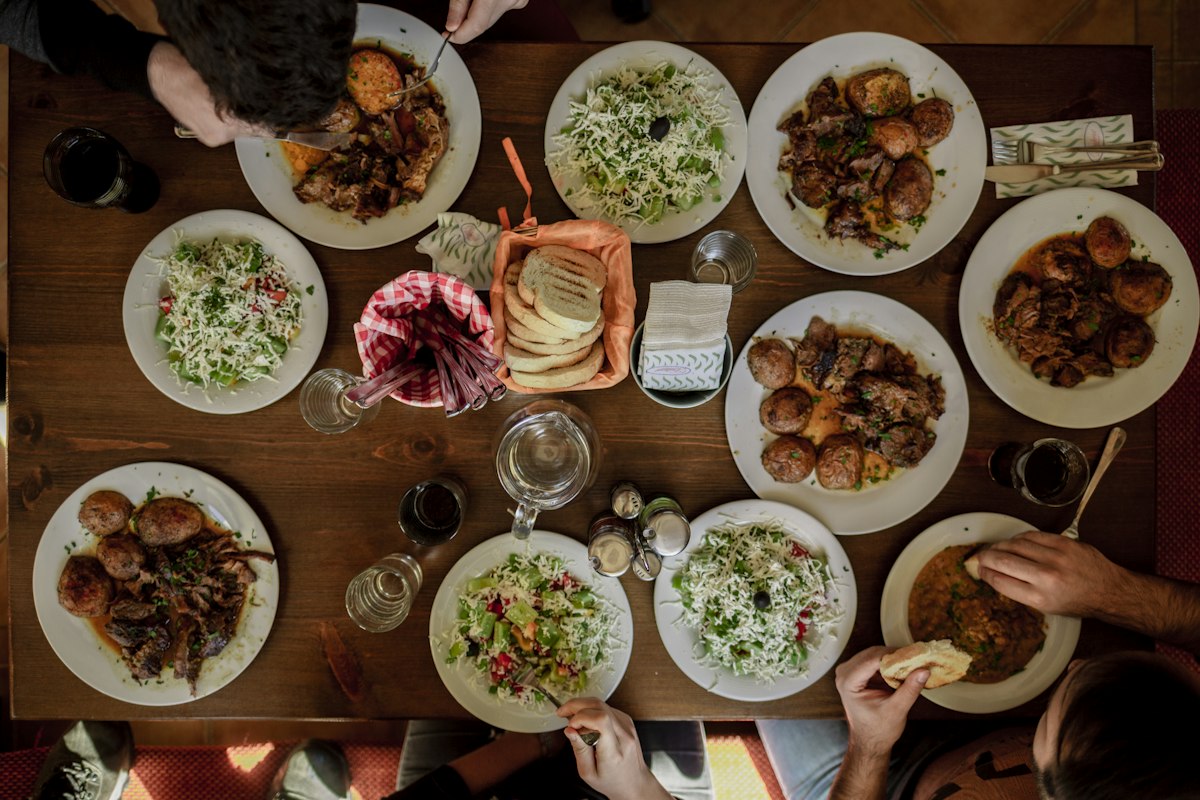
Food Is More Than Fuel
We talk about food in terms of macros, calories, and meal prep. We label it clean or dirty, good or bad. Somewhere along the way, we turned eating into a performance metric — something to optimise rather than enjoy. But the relationship between food and how we feel is far richer and more interesting than any nutrition label can capture.
What we eat affects our mood. How we eat affects our relationships. And who we eat with can shape the entire trajectory of our emotional life.
This isn't soft thinking. It's hard science. And when you look at the research — particularly from UK institutions studying the links between diet, mental health, and social connection — the picture that emerges is both fascinating and deeply practical. Food isn't just sustenance. It's medicine, ritual, and one of the oldest forms of human care.
Your Gut Is Talking to Your Brain
One of the most significant discoveries in nutritional science over the past decade has been the gut-brain axis — a two-way communication system between your gastrointestinal tract and your central nervous system. Your gut and your brain are in constant conversation, exchanging signals via the vagus nerve and through neurotransmitters like serotonin.
Here's the part that surprises most people: roughly 90% of the body's serotonin — the neurotransmitter most associated with mood regulation, happiness, and emotional stability — is produced in the gut, not the brain. Research published in the British Medical Journal confirms that dietary patterns significantly influence mental health, with certain diets promoting psychological wellbeing while others contribute to mood disorders.
The British Dietetic Association puts it plainly: what you eat directly affects your brain chemistry. Foods rich in tryptophan — like chicken, eggs, cheese, and nuts — provide the building blocks your body needs to produce serotonin. A healthy, diverse gut microbiome makes those nutrients more bioavailable, meaning your body can actually use them.
This isn't about following a trendy diet. It's about understanding that the food on your plate has a direct line to how you feel when you wake up tomorrow morning.
The Comfort Eating Trap
When we're stressed, anxious, or low, most of us reach for food. A 2025 meta-analysis published in the British Journal of Psychology found that around 64% of people experiencing perceived stress are also emotional eaters. In the UK, the connection between stress and food is deeply embedded in our culture — the biscuit tin at work, the chocolate after a bad day, the takeaway when you can't face cooking.
There's a biological reason for this. Negative emotions trigger increased levels of ghrelin, a hormone that signals hunger and activates the brain's reward centre, pushing us towards calorie-dense comfort foods. In the short term, it works. Sugar and fat trigger dopamine release, providing a brief mood lift. But the relief is fleeting, and the cycle — stress, eat, guilt, more stress — is self-reinforcing.
Emotional eating isn't a character flaw. It's a neurochemical response to stress. But there's a crucial difference between eating to numb a feeling and eating as part of a meaningful social experience. The former isolates us. The latter connects us.
The distinction between comfort eating alone and sharing a meal with others isn't just philosophical — it's physiological. When you eat alone to soothe stress, your body gets the calories but misses the social signals that trigger deeper wellbeing. When you eat with others, something fundamentally different happens in your brain — something we explore in depth in why the dinner table acts as a sanctuary.
What Happens When We Eat Together
Professor Robin Dunbar at the University of Oxford conducted a landmark study in 2017 examining the effects of communal eating on social bonding and wellbeing. His findings were striking: people who eat socially more often feel happier and more satisfied with life, are more trusting of others, are more engaged with their local communities, and have more friends they can depend on for support.
The mechanism is partly chemical. Social eating triggers the release of beta-endorphins — the same neurochemicals involved in the "runner's high" and the warm feeling after a good laugh. These endorphins are the principal psychopharmacological mechanism behind human social bonding. Dunbar's research suggests that the act of eating itself may trigger endorphin release, and doing so in a social context amplifies the effect through behavioural synchrony — the unconscious mirroring and rhythm-matching that happens when people share an experience.
Put simply: eating together makes your brain reward you for connecting with other people. It's not just pleasant. It's chemically reinforcing. That's a big part of how sharing a meal can genuinely change your social life.
The UK's Solo Dining Problem
Here's where the statistics tell a sobering story. Research covered by FMCG Magazine found that almost half of all meals in the UK are now eaten alone. The average British adult eats 10 meals out of 21 alone every week, and a third of weekday evening meals are consumed in isolation. A Greene King study revealed that four in five UK workers typically eat lunch alone.
A third of British adults can go an entire week without sharing a single meal with another person. When you consider Dunbar's research on how communal eating drives wellbeing, that statistic becomes more than a lifestyle observation — it's a public health concern.
This isn't just about busy schedules, though that's part of it. The shift towards remote work, the decline of the traditional family dinner, the rise of desk lunches and on-the-go eating — all of it has quietly eroded one of humanity's oldest social rituals. We've made eating more efficient and less human at the same time.
The ONS reported in early 2025 that around 27% of UK adults feel lonely always, often, or some of the time. Age UK's research showed that 30,000 older people in the East of England alone would be eating Christmas dinner by themselves. These numbers aren't disconnected from the solo dining trend. When we stop eating together, we lose one of the most natural, low-pressure opportunities for connection that exists. Maintaining a regular social calendar has measurable mental health benefits that compound over time.
Cooking as an Act of Care
There's another dimension to food and emotional wellbeing that goes beyond eating: the act of preparing food for someone else. When you cook for another person — whether it's a partner, a friend, a neighbour, or a table full of strangers — you're performing one of the most fundamental acts of care available to a human being.
Think about it. You're choosing ingredients with someone else's enjoyment in mind. You're investing time and effort into something that will nourish them. You're creating an experience — a smell, a taste, a moment — that you'll share. It's intimate without being intrusive. It's generous without demanding anything in return.
This is why food features so prominently in every culture's expressions of love and hospitality. The neighbour who brings a casserole when someone's ill. The friend who turns up with a homemade cake. The parent who always makes your favourite meal when you visit. These aren't just kind gestures. They're acts of emotional labour that communicate something words often can't: I was thinking of you. I took time for you. You matter to me.
In a culture that increasingly defaults to convenience — ordering in, eating at our desks, grabbing something pre-packaged — the decision to cook for someone or to sit down and eat together is a quiet act of resistance. It says: this relationship is worth my time.
The Mediterranean Lesson
There's a reason researchers keep pointing to Mediterranean cultures when studying the relationship between food and wellbeing. It's not just the olive oil and the fresh vegetables, though those help. It's the way food is treated as a social event rather than a biological necessity.
In Italy, Spain, and Greece, meals are long. They're shared. They involve conversation, laughter, multiple courses, and an almost stubborn refusal to rush. The table is where families reconnect, where friendships are maintained, where the day's events are processed and made sense of together.
The health benefits of the Mediterranean diet are well documented. But researchers increasingly believe that the social context of eating — the conviviality, the regularity of shared meals, the cultural norm of gathering around food — is as important as the nutritional content. A BMJ review on food and mood noted that the relationship between diet and mental wellbeing involves not just what we consume but how we consume it.
We're not suggesting everyone needs to adopt a three-hour Italian lunch habit. But the principle is sound: when food becomes an occasion rather than an interruption, everyone at the table benefits.
What Community Meals Can Do
The evidence for structured communal dining is particularly encouraging. Research into community meal programmes across the UK has found that 92% of guests leave feeling happier, 88% feel more part of their community, and 84% feel less lonely. Those numbers are remarkable for any intervention, let alone one that essentially involves sitting people down and giving them dinner.
You don't need to host an elaborate dinner party to experience the benefits of communal eating. Start with one shared meal a week — invite a colleague for lunch, suggest a midweek dinner with a friend, or join a community dining event. Consistency matters more than formality.
What makes communal meals so effective is that they remove the barriers that prevent many people from socialising. You don't need to plan anything. You don't need to be brilliant at conversation. You don't need to already have friends to bring along. You just need to show up, sit down, and eat. The food provides a natural rhythm and focus. The shared experience provides common ground — and in times like these, creating space for joy through simple pleasures like a good meal matters more than ever. And the relaxed setting — no agenda, no performance pressure — creates the conditions where genuine connection can emerge.
This is something we see at every Dinners With Friends event. People arrive slightly nervous, often alone. By the time the starters arrive, the table is alive with conversation. By dessert, numbers are being exchanged and plans are being made. The food isn't incidental to this process — it's central. It gives people permission to relax, to linger, to open up in ways they might not in a bar or at a networking event.
Reclaiming the Table
The relationship between food and emotional wellbeing isn't complicated, but it does require intention. In a world designed to keep us busy, distracted, and eating on the move, choosing to sit down and share a meal with someone is a small but meaningful act.
It's good for your gut. It's good for your brain chemistry. It's good for your relationships. And it might be one of the most natural, enjoyable ways to address the loneliness and disconnection that so many of us are quietly experiencing.
You don't need a special occasion. You don't need to be a great cook. You just need a table, some food, and someone to share it with. The rest takes care of itself — it has done for thousands of years. You can explore our venues across Devon or find an upcoming event to get started.
If you're looking for a place to start, we'd love to help.