
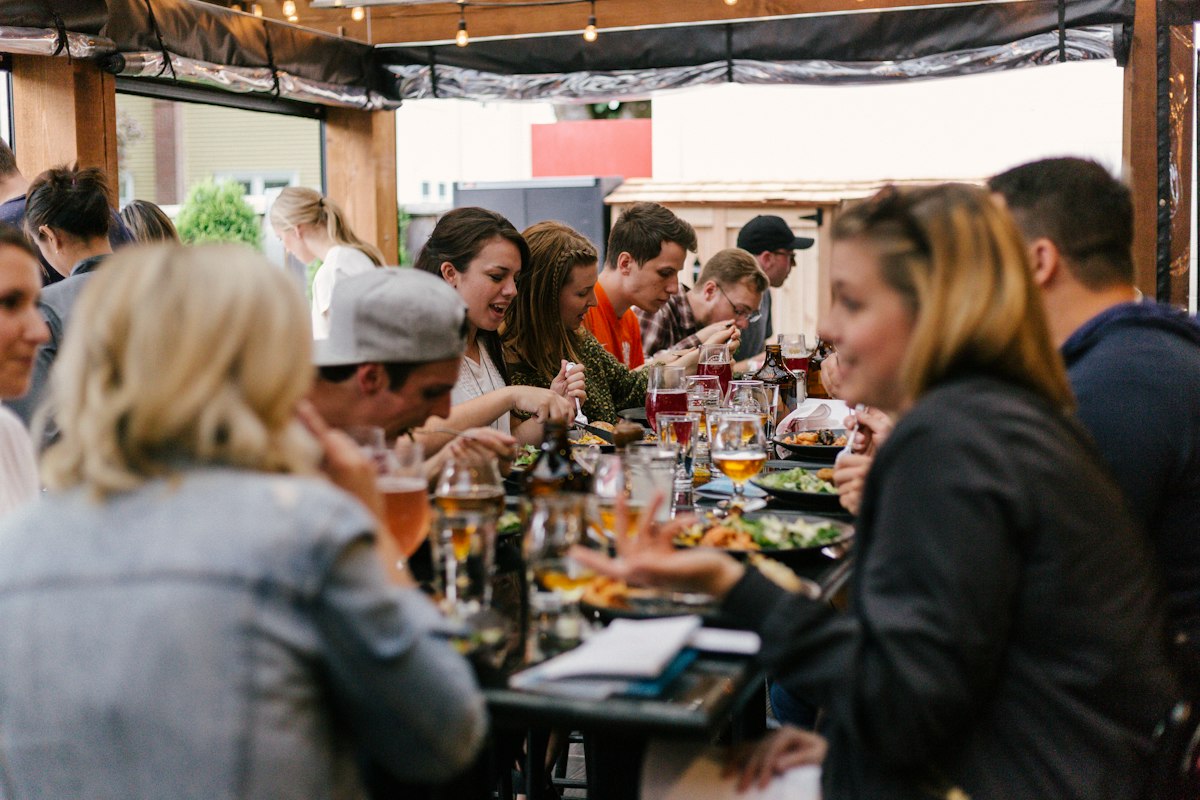
In short
Eating together measurably makes people happier: Oxford research led by Robin Dunbar found that people who share meals more often report greater life satisfaction, more trust, and stronger community ties, and the World Happiness Report now treats shared meals as a global predictor of wellbeing — as reliable as income.
We've Always Known It, Science Has Finally Proved It
Think about the happiest moment of the last month. Not the promotion, not the holiday booking, not the thing you bought yourself online at midnight. The moment that actually made you feel something. There's a good chance it involved food — and other people.
Christmas dinner with the family. A long, slow lunch with old friends. That spontaneous takeaway on the kitchen floor with someone you love. We instinctively understand that sharing a meal is about far more than calories — but until relatively recently, science hadn't properly examined why.
Over the past decade, researchers in psychology, neuroscience, and evolutionary anthropology have started to unpick exactly what happens when humans eat together. And the findings are remarkable. Sharing food doesn't just feel good. It triggers a cascade of neurochemical responses that build trust, deepen bonds, and make us genuinely happier people.
At Dinners With Friends, this isn't just interesting reading — it's our entire reason for existing. We bring people together over meals because we believe it's the most natural and powerful way to build real friendships. Here's the science that backs that up.

The Oxford Study That Changed Everything
In 2017, Professor Robin Dunbar of the University of Oxford published a landmark study called "Breaking Bread: The Functions of Social Eating." Using a nationally stratified survey of 2,000 UK adults, polled by OnePoll in April 2016 in collaboration with the Eden Project's Big Lunch, he set out to test whether eating with others provides measurable social and individual benefits.
The results were striking. People who eat socially more often:
- Feel happier and more satisfied with life
- Are more trusting of other people
- Are more engaged with their local communities
- Have more friends they can depend on for support
Perhaps most importantly, a path analysis in the study suggests the causal direction runs from eating together to bondedness — not the other way around. Dunbar is careful to note that settling the question outright would need an experiment, not a survey. But it's not simply that happy, sociable people eat together more. The act of sharing a meal itself appears to make people feel closer.
The numbers behind the headline are worth sitting with. Seventy-six per cent of respondents told the Oxford survey that sharing meals brings people closer together. Nearly seventy per cent had never shared a meal with a neighbour. The Big Lunch's release of the same survey put more numbers on it: a third of weekday evening meals in the UK were being eaten alone, the average adult was eating ten of their twenty-one weekly meals in complete isolation, and one in five grown-up children hadn't shared a meal with their parents in at least six months.
Dunbar himself put it bluntly when the findings were published. "In these increasingly fraught times, when community cohesion is ever more important," he said, "making time for and joining in communal meals is perhaps the single most important thing we can do — both for our own health and wellbeing and for that of the wider community." He described social eating as having "an important role in the facilitation of social bonding," adding that "communal eating may have even evolved as a mechanism for humans to do just that."
Dunbar's research found that evening meals resulting in the strongest bonding involved more people, more laughter, more reminiscing, and — perhaps unsurprisingly — alcohol. The ingredients for a great dinner party haven't changed much since our ancestors gathered around the fire.
The study also revealed something that anyone who's ever hosted a dinner knows intuitively: the conversations that happen around a table are different from those that happen anywhere else. There's something about the rhythm of eating — the pauses, the passing of dishes, the shared experience of tasting — that creates space for people to open up in ways they might not otherwise. We've written more about how to make the most of those conversations in our guide to moving past small talk.
The 2025 World Happiness Report: Shared Meals as a Global Predictor of Wellbeing
If the Oxford "Breaking Bread" paper was the opening chapter, the 2025 World Happiness Report wrote the definitive sequel. Researchers from Oxford, Harvard, University College London and the Gallup organisation surveyed more than 150,000 people across 142 countries in 2022 and 2023, and devoted an entire chapter to a single question: does sharing meals actually make people happier?
The answer was unambiguous. Meal sharing ranks among the strongest predictors of subjective wellbeing — on par with income and employment status. People who share more meals with others report significantly higher life satisfaction and more positive daily emotions, regardless of age, gender, country or culture. The effect held up across every region studied. As National Geographic reported, communal dining may be one of the most overlooked tools we have in the fight against the loneliness epidemic.
The global patterns were fascinating. Countries such as Senegal, Gambia, Malaysia and Paraguay led the world, with residents sharing eleven or more meals with others each week. At the other end of the scale, in the United States, by 2023 roughly one in four Americans were eating every meal alone — a 53 per cent increase since 2003. The UK sits somewhere in between, but the direction of travel is the same: fewer shared meals, more isolation, less happiness.
What makes the 2025 report particularly powerful is its scale. The meal-sharing questions were run as a dedicated module of the Gallup World Poll, funded by the Ajinomoto Group, and analysed by the report's academic authors. It sits inside one of the most authoritative annual publications on human wellbeing in the world, and it concluded — plainly and at length — that eating with other people is one of the simplest, most accessible things any of us can do to feel better. If you've been looking for a reason to host your own dinner, the World Happiness Report just gave you one backed by data from 142 countries.
What Dunbar Taught Us at Oxford — and What He's Said Since
It's easy to treat the "Breaking Bread" paper as a one-off curiosity. It wasn't. It sits inside decades of research by Dunbar and his colleagues at Oxford's Institute of Cognitive and Evolutionary Anthropology, much of it pointing at the same conclusion: friendship is not a luxury item. It's a biological necessity, and shared meals are one of the most reliable ways we have to feed it.
Dunbar is perhaps best known for the concept bearing his name. Dunbar's number — roughly 150 — is the cognitive limit on how many stable relationships any of us can realistically maintain. Nestled inside that 150 are smaller, more intense concentric circles: around fifty "good" friends, fifteen close friends you'd turn to in a crisis, five shoulder-to-cry-on intimates, and a core of one or two people who matter most. Every one of those layers has to be actively fed, and shared activity — especially shared food — is how we feed them.
His more recent work has sharpened the message. In a 2025 paper in the Annals of the New York Academy of Sciences titled "Why friendship and loneliness affect our health," he writes that the single best predictor of mental health, physical health and even longevity is simply the number and quality of close friends and family. In his 2021 book Friends: Understanding the Power of Our Most Important Relationships, he puts the comparison more bluntly still: the number and quality of our friendships has a bigger influence on our happiness, health and mortality risk than anything else except giving up smoking. Friendships don't just make life nicer. They literally make life longer.
Dunbar's work is equally blunt about the maintenance cost. Relationships decay without contact, and the closest layers need the most of it. A shared dinner does a week's worth of that work in a single sitting.
What's Happening in Your Brain When You Share a Meal
The social bonding that happens over food isn't just a pleasant feeling. It's a measurable neurochemical event.
The Endorphin Effect
Dunbar's broader body of work on the social brain hypothesis has shown that activities like laughter, singing and dancing trigger the brain's endorphin system — and he argues that the act of eating together may well do the same, though that part is a hypothesis rather than something his survey measured. Endorphins are the body's natural opioids, the same chemicals responsible for "runner's high." They create feelings of warmth, contentment, and connection with the people around you.
What makes a shared meal particularly effective at triggering endorphin release is the combination of pleasurable activities happening simultaneously. You're tasting good food, you're laughing, you're telling stories, you're perhaps enjoying a glass of wine. Each of these activities independently activates the endorphin system. Together, they create a powerful bonding cocktail. Dunbar's paper notes that laughter, singing, dancing and storytelling are each known triggers of the endorphin system — the mechanism it identifies as underpinning social bonding in primates and humans — and that alcohol is a major trigger in its own right.
Oxytocin and Trust
Oxytocin — sometimes called the "cuddle hormone" — is another key player, though the clearest evidence comes from our nearest relatives rather than from us. Research published in Proceedings of the Royal Society B in 2014 found that wild chimpanzees in Uganda had significantly higher urinary oxytocin after sharing food with another group member than after feeding alongside them without sharing.
Oxytocin is the neurochemical most closely associated with trust, attachment, and social bonding in humans too. It's the same hormone released during breastfeeding, physical touch, and moments of deep connection between people. That food-sharing moves the dial on it in chimpanzees is suggestive rather than conclusive for us — but it fits what everyone already senses about why meals feel intimate, and why business deals, peace treaties, and marriage proposals so often happen over dinner.
Synchronised Behaviour
You don't need to invoke mirror neurons to see what synchrony does at a table. People who enjoy an interaction synchronise their behaviours more, and increased synchrony makes people enjoy their interaction more — a virtuous cycle that a shared meal naturally facilitates.
Dunbar's own group has spent years measuring this in other settings: rowers pulling in time, dancers moving in unison, singers in a choir. The mechanism it points to is the same endorphin system that shows up over dinner — and a meal is one of the easiest ways for a group of people to fall into a rhythm together without anyone deciding to.

790,000 Years of Eating Together
The science of social eating becomes even more compelling when you zoom out to the evolutionary timeline.
Fire, Hearths, and the Birth of Community
The earliest evidence we have of fire being used in one spot, repeatedly, dates back around 790,000 years — burned seeds, wood and flint at Gesher Benot Ya'aqov in Israel, reported in Science in 2004, clustered in a way the excavators thought might mark hearths. When our ancestors learned to control fire and cook food, the consequences were enormous — not just nutritionally, but socially. Harvard primatologist Richard Wrangham has argued that the adoption of cooking was one of the pivotal moments in human evolution, allowing our brains to grow larger while our digestive tracts shrank.
But perhaps just as significant was the social transformation. Cooking created a reason for people to gather in one place, to wait, to share. The hearth became the centre of family and community life. Pair bonding and the formation of family units around a shared cooking fire became an evolutionarily stable strategy — one that persists to this day in the form of the kitchen table.
The word "companion" comes from the Latin com panis — literally "with bread." Even our language remembers that the deepest human connections are forged over shared food.
A Human Universal
Anthropologists classify communal eating as a "human universal" — a behaviour found in every known culture throughout history. The specific forms vary enormously. The Japanese kaiseki meal is a choreographed sequence of seasonal dishes designed to create harmony. Ethiopian gursha involves feeding someone by hand as a gesture of love and respect. The Mediterranean mezze spread invites everyone to share from the same plates, blurring the boundaries between self and other.
Religious traditions across the world centre sacred rituals around shared food: the Christian Eucharist, the Jewish Passover Seder, the Muslim iftar that breaks the Ramadan fast. Weddings, funerals, harvests, and homecomings — the moments that matter most in human life are almost always marked by eating together.
This universality tells us something profound. Communal eating isn't a cultural quirk or a learned habit. It's a deep biological drive, shaped by hundreds of thousands of years of evolution, that continues to define how we form and maintain our social bonds.
The UK's Eating-Alone Crisis
Here's the uncomfortable bit. Despite being hardwired to bond over food, we Brits are quietly drifting away from the shared table — and the evidence is piling up.
The Sainsbury's Living Well Index, built with Oxford Economics on a NatCen Social Research survey, found that eating alone most or all of the time was one of the strongest predictors of loneliness in Britain, and that one in ten people reported feeling lonely all or most of the time (2018 edition). The report's authors identified the drop in social eating as a key driver behind falls in the overall index score.
Research commissioned by the pub group Greene King in 2024 found that eighty-four per cent of UK workers — more than twenty-five million people — "always, often or sometimes" eat lunch alone. Nearly nine in ten (89%) said eating with others actively improves their mood. We know what makes us feel better. We're just not doing it.
The Office for National Statistics puts the number of adults in Great Britain who feel lonely "often or always" at around 3.9 million, roughly seven per cent of the population. Younger adults are worst affected: ONS data consistently shows younger adults reporting chronic loneliness at higher rates than the over-70s, the opposite of what most people assume. It is also, almost perfectly, the demographic most likely to eat sat on a bed, scrolling, with a bowl on their lap.
Chronic loneliness is now linked to a raised risk of heart disease, stroke, dementia and premature death — with Julianne Holt-Lunstad's widely cited meta-analysis putting its mortality effect on a par with smoking around fifteen cigarettes a day. If you want the full picture, our piece on what loneliness actually does to your brain and body digs into the biology.
None of this is an accident. Remote working, the death of the proper lunch break, the rise of the meal deal, delivery-app dinners, and the quiet retreat of the British high street have all conspired to strip the social element out of eating. The good news is that the fix is remarkably simple — and it's been right in front of us all along.
If you're finding that your social life has narrowed, you're not alone — and our piece on why consistency matters in friendships explores why making regular commitments to see people is so important.
A Devon Table: Why the Southwest Does Shared Meals Differently
We run Dinners With Friends from the Southwest, and it's no coincidence. There are few corners of the UK where the shared meal is still so stitched into daily life as it is in Devon.
Start with the obvious one: the Sunday roast. In much of the country, Sunday lunch has quietly shrunk from a household ritual to an occasional treat. Not here. Across the county — from proper country pubs on the edge of Dartmoor to farm-shop kitchens in the Exe Valley — the Sunday roast is still an anchor of the week. Places like our favourite Sunday roast spots around Exeter and Devon are full by one o'clock on a Sunday, three and four generations round a single table, a jug of gravy moving steadily from hand to hand. That rhythm isn't nostalgia. It's one of the most effective social bonding rituals we have left.
Then there's the farm-to-fork tradition. Devon has always taken its food personally. Greendale Farm Shop in East Devon serves meals made from produce grown in the fields around the building. Darts Farm near Topsham runs restaurants, a deli, and a vineyard from the same site. Powderham Farm Shop sits on the banks of the Exe Estuary, with a butchery and a bistro on site. The same instinct runs through the county's artisan cheesemakers — Quicke's, a family that has farmed the same Devon valley since the 1540s; Sharpham on the banks of the Dart; Beenleigh Blue, one of only a handful of British ewes'-milk blues. When you eat in places like these, the distance between field and plate collapses — and so does the distance between the people around the table. It's genuinely hard to scroll your phone when you're being handed a plate of roast pork from a pig that lived four miles away.

Exeter's food markets keep the thread going in the city itself. The Exeter Farmers' Market sets up every Thursday on the corner of Fore Street and South Street. The Quayside Farmers' Market — launched in 2025 — now runs on the third Saturday of each month, and it's less a shopping trip than a low-key community event. People bump into neighbours, stand around eating pasties, end up making plans. It's exactly the kind of informal commensality Dunbar's team keeps measuring the benefits of, just dressed up as a weekly errand.
And then there's the coast. The simplest, most democratic, most gloriously British form of commensality is a bag of fish and chips eaten on a sea wall with the people you love — which is why we wrote a whole guide to the best fish and chips in Exeter and Devon. The plan sounds almost too basic to be a social event: drive to the coast, queue for chips, find a bench. And yet, those are the dinners people remember thirty years later. The seagulls, the vinegar, the shared portion, the walk back to the car in the fading light. Dunbar's research is describing the neurochemistry of that exact scene.
Devon also sits at the heart of the Eden Project's orbit, and that matters. The Big Lunch — the UK's biggest annual neighbourhood get-together — was dreamed up at Eden in Cornwall back in 2009 and has grown into something extraordinary. Over ten million people took part in 2025 alone, and since 2015 Big Lunch events have collectively raised more than £100 million, around three-quarters of it going to local charities. In South Molton, in North Devon, The Benita Project served a two-course "friendship meal" as its 2025 Big Lunch, specifically designed to reach people struggling with isolation and food poverty. It is, in other words, the Oxford study in practice — and Devon has been quietly leading the charge.
We've written about this movement at length in what happens when a whole town eats together: The Big Lunch and community meals and in our love letter to Devon's food and drink heritage. They're worth a read if you want the full flavour of why we think the Southwest gets this right.
The Dinner Table as Social Technology
When you think about it in evolutionary terms, the dinner table is one of humanity's oldest and most effective social technologies. It solves a problem that has faced every human community throughout history: how do you get a group of individuals to trust each other, cooperate, and form lasting bonds?
The dinner table does this through a remarkably elegant combination of mechanisms:
Shared vulnerability. Eating is an inherently vulnerable act. You're taking something into your body. When someone prepares food for you, you're trusting them. This creates a foundation of mutual trust that's hard to replicate in other social settings.
Enforced presence. A meal takes time. You can't eat a three-course dinner in five minutes. The simple fact of sitting together for an extended period creates opportunities for conversation to deepen — moving beyond surface-level pleasantries into genuine connection. If you're looking for ways to make those conversations richer, our collection of conversation starters beyond "what do you do?" is a great place to start.
Sensory richness. Taste, smell, texture, temperature — eating engages all the senses simultaneously. Shared sensory experiences create stronger memories and more intense emotional associations than purely verbal interactions.
Equality. Around a table, hierarchies flatten. The CEO and the intern both need to eat. The act of sharing food creates a temporary equality that allows relationships to form across social boundaries.
Phones put away. A proper dinner makes the phone feel rude in a way that few other settings do. That on its own changes the quality of the conversation — something we've written more about in why putting your phone away changes everything.
Research by Kaitlin Woolley of Cornell and Ayelet Fishbach of Chicago Booth, published in Psychological Science in 2019, found that people eating from a shared plate cooperated more in negotiations than people eating identical food from separate plates. The act of sharing itself is what matters. It's the entire argument for cuisines built around the shared plate — the reason we love a good Thai or Southeast Asian dinner in Exeter, where the table orders together and everything arrives at once.
Cooking Together: The Bonding Starts Before Anyone Sits Down
A 2025 study in the journal Healthcare added a dimension that the earlier research had only hinted at: the social bonding benefits of shared meals may begin in the kitchen, not at the table. In a survey of 461 people from families in Taipei, researchers found that households who cooked and ate together reported higher psychological flourishing and family wellbeing. It's a snapshot rather than an experiment — but the preparation process is where the authors think a good deal of the communication and cohesion actually happens.
This chimes with something anyone who's ever cooked with friends already knows. Chopping onions side by side, passing ingredients, arguing gently about how much garlic is too much garlic — these moments are intimate, collaborative and surprisingly funny. The shared activity creates the same kind of synchronised behaviour that triggers endorphin release. By the time you sit down to eat, you've already done half the bonding.
It's also worth noting that cooking together solves one of the biggest barriers to social eating: the pressure on the host. When everyone chips in — whether that's a full potluck supper or simply helping prep in someone's kitchen — the hosting burden evaporates, and the evening becomes genuinely collaborative. If you've ever felt that hosting is too stressful, our guide to hosting when you're not a natural host is worth a read.
Next time you invite friends for dinner, ask them to arrive an hour early and help cook. The bonding begins with the first chopped onion — and we tend to value things we helped make more highly than things handed to us, the effect Norton, Mochon and Ariely named the "IKEA effect."
Practical Rituals: Eating Together in 2026
You don't need a PhD in evolutionary psychology to put this research into practice. The takeaway is beautifully simple: eat with other people more often.
Not scrolling through your phone while eating a sandwich at your desk. Not heating up a ready meal and eating it on the sofa in front of Netflix. Actually sitting down with other humans, sharing food, talking, laughing, being present.
Here are some practical ways to build more shared meals into your life, shaped for the realities of 2026:
- Protect one lunch a week. If you work from home and feel isolated, this is the single most impactful change you can make. Meet a friend, a neighbour, or an old colleague for a proper hour-long lunch once a week. That's fifty-two shared meals a year you weren't having before.
- Turn Sunday lunch into a standing invite. Pick a Sunday a month. Tell the same three or four people it's permanently on. It stops being a logistical hassle ("when are we next free?") and starts being a rhythm.
- Host small, host often. One bowl of pasta, one salad, one bottle of something decent. Four chairs. That's all you need. The food is the excuse; the connection is the point.
- Join in with the Big Lunch. The first weekend of June, every year. Your street, your flats, your church hall, your front garden. Even the smallest version counts.
- Eat at the market. Grab a pastry and a coffee at Exeter Farmers' Market on a Thursday. Stand at a table. Say hello to someone. That tiny friction between strangers is how weak ties become strong ones — and weak ties matter more than you think. Our guide to Exeter's best food markets and street food has the full list of where and when.
- Cook together. The bonding benefits extend to the preparation. Invite a friend round an hour before dinner and chop onions side by side. It's intimate, collaborative, unexpectedly funny, and the meal tastes better when you've made it together.
- Lose the phones. Basket by the door. One hour minimum. Watch what happens.

If any of this feels daunting — the hosting, the inviting, the sheer activation energy of making plans — you're not the only one. Our piece on the art of the midweek catch-up and the dinner table as sanctuary are written for exactly that feeling.
Frequently asked questions
- Why does eating together make us happier?
- Shared meals trigger endorphin release, synchronise behaviour, and create the low-pressure conditions in which trust forms. Oxford's research under Robin Dunbar found the more often people eat with others, the happier and more socially connected they report being.
- What did the Oxford study on communal eating find?
- Professor Robin Dunbar's Oxford research found people who eat socially more often feel happier, are more satisfied with life, trust others more, and have larger support networks — with evening meals shared with friends especially powerful.
- How long have humans eaten together?
- Archaeological evidence of repeated fire use in one place goes back around 790,000 years — long enough that our social brains are effectively built around the shared table.
- Does eating alone affect wellbeing?
- Yes — regular solo dining correlates with lower life satisfaction and weaker social networks, and the UK ranks among the countries where eating alone is most common. Rebuilding shared-meal habits is one of the most evidence-backed wellbeing interventions available.
The Ancient Truth We Built a Company On
When we started Dinners With Friends, we weren't thinking about oxytocin pathways or endorphin systems. We were thinking about something much simpler: that sitting down to eat with other people is one of the best things you can do with your time, and that too many people aren't doing it enough.
The science has caught up with the instinct. Robin Dunbar's research at Oxford, the endorphin and oxytocin work, the 790,000-year archaeological record of fire kept in one place, the steady drumbeat of ONS and Sainsbury's data on just how alone Britain has started to feel — it all points to the same conclusion. Sharing food is how humans bond. It always has been. And in a country increasingly isolated and screen-mediated, it matters more than ever.
So the next time someone invites you to dinner, say yes. And if nobody's inviting you, come and join us. That's what we're here for.