
The Universal Social Technology
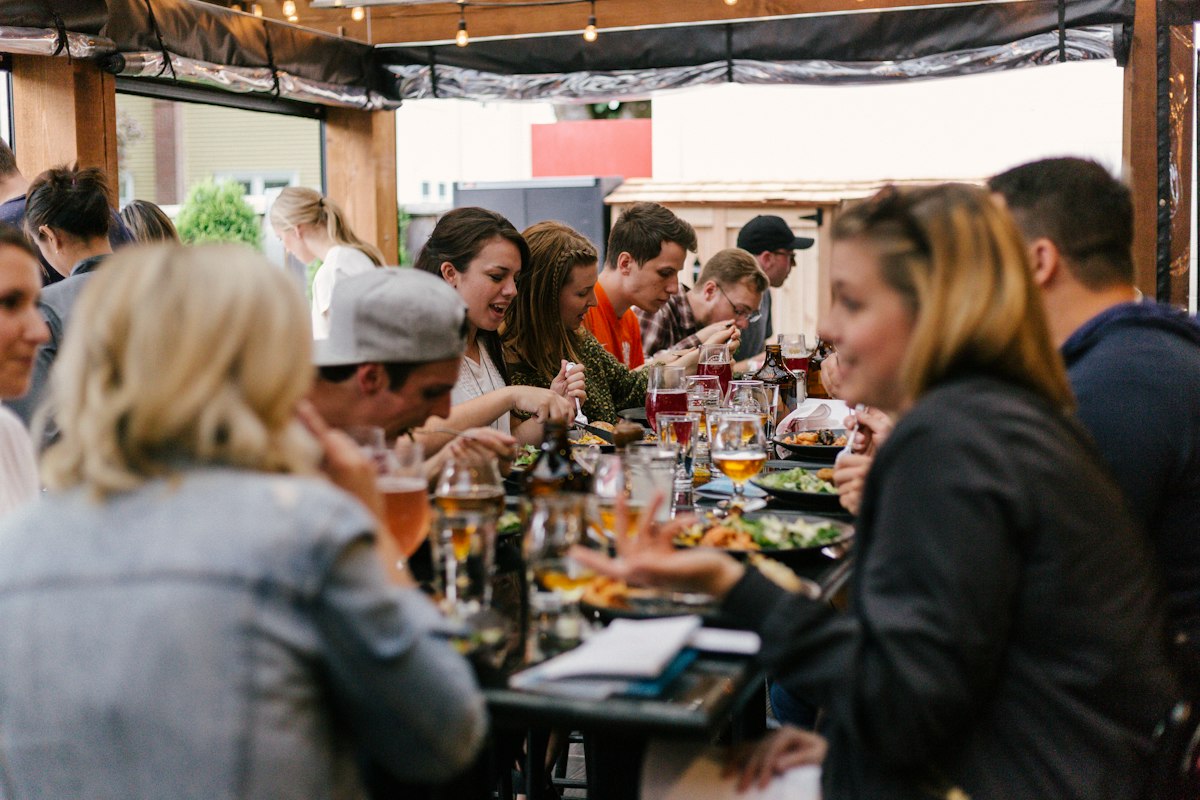
Every culture on earth has worked out the same thing: if you want to bring people together, put food in the middle.
This is not a coincidence. Robin Dunbar's national survey research at the University of Oxford found that people who eat with others more often report feeling happier, more satisfied with life, more trusting of those around them, and more connected to their local communities — and his path analysis suggests the causal direction runs from eating together to bonding, not the other way around. It is not simply that close friends eat together. It is that eating together makes people close. The evening meals that left people feeling closest, Dunbar found, involved more people, more laughter, more reminiscing — and, he noted, more alcohol. Laughter is one of the reliable triggers of the endorphin system that underpins human social bonding, which is the mechanism doing the work here: not the food itself, but what happens around it.
Every civilisation has understood this intuitively and built social rituals around the table. But the specific ways different cultures have embedded food into their social fabric vary enormously — and each has something to teach us about what connection through food can look like.
Because here in the UK, we have largely forgotten.
Italy: The Art of the Aperitivo
In Italy, the hours between work and dinner are not dead time to be endured on a commuter train. They are the aperitivo — a ritual so deeply embedded in Italian life that it functions almost like a national social policy.
The aperitivo is deceptively simple. You meet friends at a bar or café around six in the evening. You order a drink — a Spritz, a Negroni, a glass of prosecco. With it comes food: small plates of olives, cured meats, bruschetta, focaccia. In many bars, particularly in cities like Milan and Turin, the food is laid out as a buffet and included in the price of your drink.
But the aperitivo is not really about the food or the drink. It is about the transition. It marks the moment when the working day ends and social life begins. It provides a shared ritual — a reason to stop, to gather, to be present with other people before retreating into the privacy of home. It requires no booking, no elaborate planning, no group chat that takes three days to reach a consensus. You simply go.
What makes the aperitivo so effective as social infrastructure is its regularity and its low stakes. It happens every day. It costs very little. You can stay for twenty minutes or two hours. You can go alone and bump into people you know, or arrange to meet a friend with the unspoken understanding that others will join. It is sociability with the effort stripped out.
Spain: Tapas and the Long Evening
Spanish tapas culture operates on a similar principle but extends it further into the evening. The tradition of sharing small plates — patatas bravas, gambas al ajillo, jamón ibérico, croquetas — is not merely a style of eating. It is a philosophy of social time.
In Spain, dinner rarely begins before nine or ten at night. The hours before are spent moving between bars and cafés, ordering a plate here and a glass there, standing at counters, leaning against doorways, talking. The evening is designed to be long, unhurried, and communal. There is no single destination, no fixed endpoint. The social experience is the journey itself.
Tapas forces sharing. You cannot order tapas for one person, eat them silently, and leave. The portions are designed to be passed around. You try what someone else ordered. You reach across the table. You argue about whether the tortilla is better here or at the place around the corner. The food creates conversation, and the conversation creates connection.
Robin Dunbar's Oxford research found that the meals that leave people feeling closest involve more people, more laughter and more reminiscing — and laughter is one of the reliable triggers of the endorphin system. People who eat with others more often report feeling happier, more trusting, and more connected to their communities.
Japan: The Izakaya and the Art of Unwinding
Japan's contribution to communal food culture is the izakaya — a type of informal pub-restaurant that has existed since the Edo period in the 1600s, when sake shops began letting customers drink on the premises and started offering simple snacks to accompany their beverages.
The modern izakaya is deliberately casual. You sit at shared tables or at a counter. You order multiple small dishes — edamame, yakitori, karaage, grilled fish — and share them across the group. Unlike most Japanese dining, where individual portions are the norm, izakaya food is communal. Dishes arrive in the centre of the table and everyone helps themselves.
But the real genius of the izakaya is its social function. In a culture that places enormous emphasis on hierarchy and formality in the workplace, the izakaya provides a space where those barriers dissolve. Colleagues gather after work, and the combination of food, drink, and shared plates creates an atmosphere where honest conversation becomes possible. The Japanese concept of nominication — a portmanteau of the Japanese word for "drinking" and "communication" — describes this precisely. It is communication made possible by the relaxed context of eating and drinking together.
The izakaya teaches us something important: that the right setting can unlock conversations that formal environments never will. People do not open up across a boardroom table. They open up over shared plates and a second round of drinks. It is a principle we explored in the art of conversation and how to move past small talk — the environment matters as much as the words.
Ethiopia: Breaking the Injera
Ethiopian food culture takes communal eating to its most literal and intimate expression. There are no individual plates. There are no utensils. There is injera — a large, spongy flatbread made from teff flour — laid across a shared platter, with various stews and dishes spooned on top. Everyone eats from the same surface, tearing off pieces of injera and using them to scoop up food with their right hand.
The symbolism is powerful and intentional. Eating from a shared platter, with your hands, sitting close enough that your knees touch — this is not just a way of eating. It is a declaration of trust, equality, and togetherness. Ethiopian dining has a specific word for this intimacy: gursha, the act of taking a morsel of food wrapped in injera and placing it directly into another person's mouth. You might feed a guest, an elder, or a loved one. It is a gesture of respect, affection, and care that has no equivalent in British dining culture.
In Ethiopian tradition, the communal plate says something that cutlery and individual servings never can: we are sharing the same experience, from the same source, in the same moment. No one eats first. No one eats separately. The boundaries between self and group dissolve at the table, and what remains is simply people, together, nourishing each other.
South Korea: Cooking Together at the Table
Korean barbecue takes the idea of communal eating and adds another dimension: communal cooking. The grill sits in the centre of the table, and diners cook their own meat — slicing, grilling, flipping, wrapping it in lettuce leaves with sauces and condiments. Everyone participates. Everyone contributes. The meal is not something that arrives finished from a kitchen. It is built together, in real time, by the people eating it.
This shared act of cooking creates a social dynamic that is fundamentally different from being served. You are not a consumer. You are a participant. You negotiate the grill — offering the best pieces to others, adjusting the heat, timing the kimchi. The Korean word jeong describes the deep emotional bond that develops between people who share experiences, and the barbecue table is one of the places where jeong is most actively cultivated.
Samgyeopsal — grilled pork belly — is not special-occasion food. It is the food you eat on a Tuesday evening with the people you care about, because the act of cooking and eating together is itself the celebration.
You do not need to master Korean barbecue or Ethiopian injera to bring these principles into your own life. The common thread across every food culture is simple: shared plates, shared time, shared attention. Try serving food family-style at your next dinner gathering and watch what happens to the conversation.
India: The Thali and the Open Door
Indian thali — the traditional meal served on a large plate or banana leaf with multiple small bowls of different dishes — embodies a philosophy of abundance, variety, and inclusivity. A thali is designed to offer something for everyone: different flavours, textures, and spice levels arranged in a careful balance.
But beyond the food itself, Indian dining culture is built on the principle of atithi devo bhava — "the guest is God." Hospitality is not merely a social nicety. It is a spiritual obligation. To turn away a hungry person, or to eat without offering to share, is a profound transgression. This ethic extends from formal occasions to everyday life. Neighbours share food across garden walls. Festival meals are open invitations. The kitchen is the beating heart of the household, and it beats for everyone.
In many parts of India, communal eating spaces — from roadside dhabas to temple langars (communal kitchens run by Sikh gurdwaras that serve free meals to anyone, regardless of religion, caste, or background) — function as some of the most egalitarian social spaces on earth. At a langar, a billionaire and a beggar sit on the same floor and eat the same food. The table, such as it is, dissolves hierarchy entirely.
What Britain Has Lost
Reading about these food cultures, you might feel a pang of recognition — or perhaps of loss. Because Britain once had its own communal eating traditions, and they have been quietly disappearing.
The Sunday roast was, for generations, the anchor of British family and social life. It was the meal that brought everyone to the same table, at the same time, every week. But a survey of 2,000 people commissioned by the supermarket Iceland and reported in March 2026 found half now fear the traditional Sunday lunch could become extinct, with 48% planning fewer roast dinners as costs rise. It is a retailer's poll rather than academic research, but the direction of travel is recognisable. Energy bills, the stress of preparation, and the simple fact that family members are no longer reliably free on the same day have all contributed to the decline. In the same survey, 62% said they feel sad that younger generations may never know the Sunday roast as a weekly fixture.
The works canteen — once a fixture of British employment — has similarly faded. During and after the Second World War, communal workplace dining was widespread, supported by government policy. Workers from all levels ate the same food in the same room. It was imperfect, certainly — the food was famously terrible — but it served a social function that the grab-and-go sandwich and the desk lunch simply cannot replicate.
Even the simple act of having people round for tea — once the default British social activity — has become something that requires planning, invitation, and a clean house. We have replaced the open door with the group chat, and the spontaneous visit with the scheduled catch-up that gets postponed three times before being quietly abandoned.
As we explored in how global uncertainty is reshaping British social life, external pressures — economic anxiety, political division, the sheer exhaustion of modern life — have made us retreat further into our private spaces. But the traditions we have lost were designed precisely to counter that retreat.
The Common Thread
Across every food culture we have looked at — Italian, Spanish, Japanese, Ethiopian, Korean, Indian — the same principles emerge again and again.
Food is served communally. Whether it is tapas, izakaya dishes, injera platters, or thali bowls, the food is designed to be shared. Individual portions create individual experiences. Shared plates create shared ones.
The meal is unhurried. Aperitivo stretches into the evening. Tapas bars are visited in sequence. Korean barbecue cannot be rushed because the cooking is the experience. Time is not something to be saved but something to be spent — together.
The setting lowers barriers. Informal, noisy, slightly chaotic environments — the izakaya counter, the tapas bar, the barbecue table — create the conditions for genuine conversation. Formality inhibits honesty. Shared plates and a bit of mess unlock it.
Hospitality is an ethic, not a transaction. In Ethiopian, Indian, and Korean cultures, feeding others is an act of care, not commerce. The host gives freely. The guest receives gracefully. Something is exchanged that has nothing to do with money.
The Community Life Survey 2024/25 found 6.6% of adults in England — close to three million people — feel lonely often or always. A 2017 study by the Centre for Economics and Business Research for the Eden Project put the annual cost of disconnected communities to the UK economy at £32 billion. Food cultures that prioritise communal eating are an ancient answer to a modern problem.
What We Can Reclaim
The good news is that none of this is lost permanently. Food cultures are not genetic. They are habits — and habits can be rebuilt.
The rise of supper clubs across the UK suggests that the appetite for communal dining is very much alive. The format — intimate, convivial, centred on shared food and conversation — is thriving precisely because it fills a gap that restaurant culture cannot.
At Dinners With Friends, we have seen firsthand what happens when you take the principles that make these global food cultures work — shared plates, unhurried time, a welcoming space, strangers treated as future friends — and apply them here in Britain. The results are remarkably consistent. People arrive nervous. They leave exchanging numbers. The food matters, but what matters more is the format: sitting together, sharing together, being present together.
As we discussed in the dinner table as sanctuary, the table is not just where we eat. It is where we become human to each other. Every culture on earth has understood this. It is time we remembered it too.
You do not need to fly to Naples or Seoul or Addis Ababa to experience the power of communal eating. You just need a table, some food worth sharing, and the willingness to sit down with other people — even people you do not yet know. Especially people you do not yet know.
Because that is how every great food culture in the world began. Not with a recipe. With an invitation.
The Science Is Catching Up With Tradition
What ancient food cultures understood intuitively, modern scholarship keeps arriving at from a different direction. A 2024 theoretical paper in the Journal for the Theory of Social Behaviour described commensality — the act of eating together — as a "commensal attraction" that functions as an evolved social tool, facilitating complex interactions from bonding over street food to the intimacy of feeding a child.
A Canadian evidence brief on social connection reaches a more measured but practical conclusion: shared meals are worth encouraging, provided they are inclusive of dietary restrictions and cultural difference.
Meanwhile, Yale's Human Relations Area Files, which catalogues cross-cultural ethnographic material, describes how comfort food and communal eating rituals turn up again and again across recorded cultures, suggesting that the link between shared food and social cohesion is not merely a local custom.
This matters because the UK is losing the places where that happens. One pub a day closed in 2025 in England and Wales — 366 of them — with average rateable values set to rise 30% from April 2026. Separately, the Night Time Industries Association counts one in four late-night venues lost since 2020. The physical spaces where Brits once gathered to eat and drink together are disappearing at an alarming rate — and with them, the casual social rituals that held communities together.
You do not need to wait for policy change to rebuild food culture in your own life. Start a monthly potluck with neighbours. Organise a rotating supper club with friends. Or join an existing social dining event where the format does the hard work for you. The simple act of sitting down to eat with other people — even people you do not yet know — is one of the most powerful things you can do for your wellbeing.
The 2025 World Happiness Report found that meal sharing ranks among the strongest predictors of subjective wellbeing, comparable to factors like income and employment status — whether someone shared a meal in the past week predicts their life evaluation better than knowing whether they are unemployed. For a country where loneliness reaches millions of adults, and where the friendship recession shows no signs of reversing on its own, the lesson from the world's great food cultures could not be more urgent.
We do not need new technology. We do not need government programmes. We need what the Italians, the Spaniards, the Japanese, the Ethiopians, the Koreans, and the Indians have never stopped doing: putting food in the middle and gathering around it. If you are new to the area or simply looking for a way to expand your social circle, a shared meal is the oldest and most effective starting point there is.
The table is waiting. The only question is whether we will sit down.