
The Weight of Worry
If you have spent any time paying attention to the world lately, you will know the feeling. A low-grade unease that sits somewhere between your chest and your stomach, fed by headlines about conflict, climate breakdown, economic instability, and the general sense that the ground beneath us keeps shifting.
You are not being dramatic. Almost 80% of UK residents expressed concern about climate change in a recent survey. Over eight in ten British adults feel worried about rising costs. The NHS has seen a steady increase in anxiety referrals since 2022, particularly among people who had never sought mental health support before. A 2025 analysis from Manchester Counselling described anxiety as no longer merely rising — it is becoming "embedded in the fabric of everyday life."
This is collective anxiety. It is not a personal failing or a chemical imbalance. It is a rational response to an irrational amount of uncertainty. And it is everywhere.
The question is not whether you feel it. The question is what you do with it.
Fight, Flight — or Something Else Entirely
Most of us were taught that the human stress response boils down to two options: fight or flight. Face the threat or run from it. But in 2000, psychologist Shelley Taylor at UCLA proposed something that changed the conversation entirely.
Looking at decades of stress research, Taylor noticed a pattern that had been largely overlooked because most of the early studies had been conducted on male subjects. When women — and, as subsequent research showed, many men too — face threat, they do not always fight or flee. Instead, they tend and befriend.
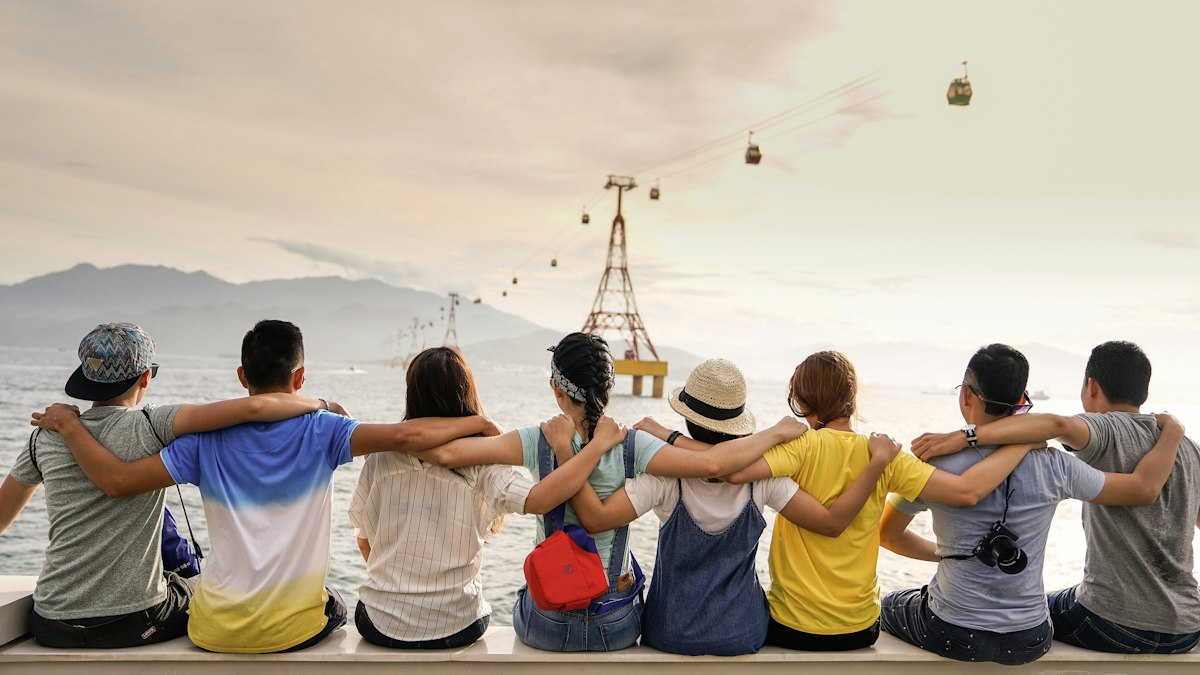
Tending means nurturing — protecting those who are vulnerable, caring for children, looking after the people around you. Befriending means seeking out social connection, building alliances, turning toward your community rather than away from it.
This is not a metaphor. It is a measurable biological response. When the tend-and-befriend response activates, the body releases oxytocin — the hormone associated with bonding, trust, and social connection. Oxytocin dampens the cortisol response, lowers blood pressure, and calms the nervous system. In other words, reaching out to other people during a crisis is not just emotionally comforting — it is physiologically protective.
The tend-and-befriend response evolved because, for much of human history, survival depended on cooperation. Isolation was not safety — it was danger. Our biology still knows this, even when our anxious minds try to convince us otherwise.
Taylor's research showed that affiliative behaviour — tending to others and seeking social bonds — reduces biological stress responses in both the person giving care and the person receiving it. The biological mechanisms behind this are explored further in our article on the science of social resilience. This is not a one-way street. Connection protects everyone involved.
What Collective Anxiety Actually Does to Us
Before we talk about channelling worry into something useful, it helps to understand what chronic collective anxiety does when left unaddressed.
When you are exposed to a constant stream of threatening information — and let us be honest, that is what the modern news cycle delivers — your stress response does not switch off between threats. It stays partially activated, like an engine idling too high. Cortisol remains elevated. Sleep suffers. Concentration frays. And your emotional bandwidth for other people narrows dramatically.
This is where anxiety becomes isolating. You are too wired to relax, too depleted to socialise, and too overwhelmed to do anything except scroll through more news that makes the whole cycle worse. The World Health Organisation's 2025 report found that loneliness is now impacting one in six people worldwide, with significant consequences for both mental and physical health.
In the UK, the Community Life Survey for 2024/25 found that 6.6% of adults — around 3.9 million people — feel lonely often or always. But the indirect measures paint an even bleaker picture: 9% of adults scored highly on a composite loneliness scale measuring feelings of lacking companionship, being left out, and feeling isolated.
Anxiety and isolation feed each other. The more anxious you feel, the more you withdraw. The more you withdraw, the more anxious you become. We have written about keeping friendships alive when the world feels overwhelming, and it speaks to exactly this dynamic. Breaking the cycle requires something that feels counter-intuitive: moving toward people rather than away from them.
Britain Has Done This Before
If the psychology of tend-and-befriend tells us what humans are wired to do during crisis, British history shows us what it looks like in practice.
The Mutual Aid Movement
When the first lockdown hit in March 2020, something remarkable happened. Within weeks, over 4,300 mutual aid groups had formed across the UK. Three million people offered support to their local communities. Ten million people — nearly a fifth of the adult population — volunteered in some capacity.
These were not government programmes. They were neighbours knocking on doors, WhatsApp groups sharing shopping lists, strangers checking in on people they had never met. The Social Change Nest supported over 300 of these groups and helped channel over £3.5 million directly to people who needed it.
The demographics were striking. Research from LSE found that more working-age people got involved in mutual aid groups than in any other kind of voluntary activity. The participants were predominantly women (84%) and ranged in age from 16 to 78.
This was the tend-and-befriend response at scale. Faced with a genuine threat, millions of people did not retreat — they reached out.
What Happened Next
Here is the uncomfortable truth: activity in many of those mutual aid groups dropped by 75% within three months. By June 2020, the initial surge of energy had faded, furlough had ended for some, and the sustained effort of community care proved harder to maintain than the initial burst of solidarity.
But the groups that survived did something important. They evolved. Many shifted from pandemic response to addressing food poverty, supporting refugees, setting up community gardens, and creating tool-sharing libraries. They became permanent infrastructure for connection, not just emergency response.
The mutual aid movement showed that when crisis creates a structure for connection, people show up in extraordinary numbers. The challenge is building structures that last beyond the initial emergency — regular gatherings, consistent communities, standing invitations that people can return to week after week.
Community Fridges, Warm Banks, and Supper Clubs
The cost of living crisis generated its own wave of community responses. Warm banks — public spaces where people could go to stay warm during the day — appeared in libraries, churches, and community centres across the country. Community fridges redistributing surplus food multiplied. Local supper clubs offering affordable communal meals became gathering points for people who might otherwise have stayed home alone.
These initiatives served a dual purpose that is easy to overlook. Yes, they addressed material need. But they also gave people a reason to leave the house, a place to be around others, and a structure for the kind of low-pressure social contact that sustains wellbeing. The warm bank was not just about heating. It was about not being alone.
Small Acts, Big Returns
One of the most paralysing things about collective anxiety is the feeling that nothing you do matters. The problems are too big, too systemic, too far beyond your control. Climate change will not be solved by your reusable coffee cup. The economy will not recover because you switched energy providers.
This is where the psychology of helplessness takes hold, and it is where small acts of community become genuinely radical.
Research into what psychologists call "self-efficacy" — your belief in your own ability to affect outcomes — shows that helplessness is not really about the size of the problem. It is about the absence of action. When you do something, even something small, the feeling of helplessness loosens its grip.
And here is the thing that makes community-building particularly effective: the benefits are immediate and tangible. You cannot single-handedly fix the housing crisis, but you can invite a neighbour for dinner and both of you will feel better for it. You cannot reverse climate change over a cup of tea, but you can have a conversation that makes you feel less alone in your worry.
The NHS Health Survey for England found that people with strong social connections report significantly better wellbeing across every measure — lower anxiety, better self-rated health, greater life satisfaction. And the Community Life Survey found that 94% of adults agree that if they needed help, there are people who would be there for them. The support is there. The challenge is activating it.
How to Channel Worry Into Connection
If you recognise yourself in any of this — the low-grade anxiety, the withdrawal, the sense that the world is too much — here are practical ways to turn that energy outward.
Start With One Person
You do not need to launch a community initiative. Start with a text to someone you have not spoken to in a while. Not a "hope you're well" that requires nothing. Something real. "I have been thinking about you. How are things actually going?" That is tend-and-befriend in its simplest form.
Show Up to Something Regular
The mutual aid research tells us clearly: one-off bursts of community spirit fade fast. What lasts is regular, repeated contact. Find something that meets weekly or monthly — a walking group, a book club, a dinner event — and commit to showing up. You do not have to feel like going. You just have to go.
Let Yourself Be Helped
Tend-and-befriend is not just about giving. It is about receiving too. If someone offers to help, say yes. If someone invites you somewhere, go. If someone asks how you are, tell them the truth. Allowing yourself to be supported is not weakness — it is the other half of the equation that makes communities work.
Talk About What Worries You
One of the most powerful things about collective anxiety is that it is, by definition, shared. The person sitting next to you at dinner is probably worried about the same things you are. Naming that — saying "I have been feeling anxious about everything lately" — is not doom and gloom. It is an invitation to connect on something real instead of pretending everything is fine.
Create a Reason for People to Gather
You do not need permission or a formal structure. Make a pot of soup. Invite three people over. Set a date for next month and do it again. The most resilient communities in history were not built by organisations — they were built by individuals who decided that isolation was not an option. If you are looking for a starting point, finding your people when everything feels unstable is a good place to begin.
Research from the University of Kansas found that it takes roughly 50 hours of shared time to move from acquaintance to casual friend. That is about one gathering a week for a year. The investment is real, but so is the return — and it starts paying dividends long before you hit the 50-hour mark.
Anxiety Is Not the Enemy
Here is perhaps the most important reframing: anxiety itself is not the problem. Anxiety is information. It is your body telling you that something matters, that there is uncertainty, that you care about what happens next.
The problem is what we do with it. Left alone, anxiety spirals inward, becoming isolation, rumination, and helplessness. But directed outward — toward other people, toward community, toward action — it becomes something entirely different. It becomes fuel. This is the difference between a social circle and a genuine support network.
The tend-and-befriend response is not a modern invention. It is ancient biology. It is what kept our ancestors alive when the world was genuinely dangerous. And it is available to every one of us, right now, in the middle of whatever crisis is making the headlines this week.
You do not have to solve everything. You just have to turn toward someone.
At Dinners With Friends, we believe that one of the most powerful things you can do during anxious times is sit down with other people over a good meal. Not to fix the world, but to remind yourself that you are not in it alone. That is not naive. That is how human beings have survived every crisis that came before this one.